"There is no limit to what a man can do or where he can go if he doesn't mind who gets the credit." - President Ronald Reagan.

Buy The Amazon Kindle Store Ebook Edition

Buy The Amazon Kindle Store Ebook Edition
Get the ebook edition here! (Click image.)
Showing posts with label shuttle bus. Show all posts

Friday, July 7, 2023

Grand Canyon National Park To Get New Shuttle Fleet

Above, one of the aging Grand Canyon shuttle buses to be replaced. Photo by Armand Vaquer.

Grand Canyon National Park will be getting a new fleet of shuttle buses to replace the aging ones the park is now using.

According to National Parks Traveler:

A new shuttle bus fleet is coming to Grand Canyon National Park thanks to a grant of $27.5 million from the U.S. Transportation Department's Federal Highway Administration.

The funding will help pay for 30 new buses, including 10 battery electric buses and 20 compressed natural gas buses, to replace the current aging fleet. It also will cover installation of charging infrastructure to support the new electric buses. An estimated 6 million people visit the park each year and use the free shuttle buses to access destinations throughout the Grand Canyon.

The project is one of seven to receive federal grants totaling $130.5 million under FHWA’s Nationally Significant Federal Lands and Tribal Transportation Projects Program. 

The shuttle bus system at Grand Canyon National Park was handy for us back in 2017 when we camped at Trailer Village at the South Rim. The bus stop was located at the campground's main entrance.

To read more, go here

Thursday, June 2, 2022

Best Campgrounds At Yosemite National Park

Above, Yosemite's North Pines Campground. Photo by Armand Vaquer.

Ever wanted to camp in Yosemite National Park but wonder which are the best campgrounds to do so?

You're in luck! Time Out USA has posted a list of the 13 best campgrounds in Yosemite National Park. I have personally camped at North Pines Campground in Yosemite Valley and enjoyed my stay there. The park's shuttle system stops near the main entrance to the campground, so one doesn't need to drive their vehicle in the park.

They begin with:

Camping is the best way to immerse yourself in a national park. But it can be hard to decide which campground you should stay at in Yosemite. Thankfully, with 13 different campgrounds (as well as a selection of backcountry areas which require a separate wilderness permit), you can choose the one that will make your trip unforgettable. A valley campground ranger once told us White Wolf and Tamarack Flat were her favorites – but really, you can’t go wrong in this beautiful park. 

There are some things you should take into account when deciding which campgrounds in Yosemite are best for you. Some sites aren’t accessible for disabled people, and some require you to treat, filter or boil creek water. If you’re bent on taking a shower, stay at one of the Pines campgrounds so you can walk to Curry Village, where the pool’s showerhouse is the only place you can hose yourself down. Take note of elevations in the descriptions; you might get short of breath at some of the higher campgrounds and wish you had brought an inhaler.

Some campgrounds are currently closed for renovations, and some only open in mid- to late-summer depending on snowload (such as Tamarack Flat, White Wolf and Yosemite Creek), which also means that certain roads in Yosemite will also be closed. If you want to bring your pet, avoid Camp 4, the only one where pets aren’t allowed. Not all campgrounds have RV parking, and only three campgrounds allows horses. All of them will have metal bear boxes to store your food and you MUST use them. Bears will break into your car or tent if you leave any food inside. And they’ll have fun doing it, too.

Finally, you must make a reservation in advance – this is the first year that there isn’t any first-come, first-serve during summer months – and read campground information carefully because each differs in what they offer. 

Otherwise, read on for the best campgrounds in Yosemite National Park. 

To see what they are, go here

Monday, May 16, 2022

Grand Canyon Shuttles

Above, a Grand Canyon shuttle bus. Photo by Armand Vaquer.

During my last visit to Grand Canyon National Park in November 2017, my roommate Jessica and I stayed at Trailer Village at the Grand Canyon Village inside the park. It is the only campground for RVs with full hook-ups. Reservations are advised.

We made extensive use of the park's shuttle system. A shuttle stop was at the entrance to Trailer Village, which made it easy. The shuttles are free, by the way.

For those who don't want to drive inside the park, shuttles are available. AZCentral posted an article on the Grand Canyon shuttles.

AZCentral starts with:

Summer is the busiest time of year to visit Grand Canyon National Park. Lines to enter the South Rim are long and parking fills up fast.

Peak-season visitors can expect up to a two-hour wait at the entrance station north of Tusayan and parking lots hit capacity as early as noon. 

Want to avoid that lengthy traffic jam and frustrating search for parking? Leave your car outside the park and ride the free Grand Canyon shuttle. 

The seasonal service begins Saturday, May 28, and connects visitors to the Grand Canyon Visitor Center where they can hop on other shuttles that traverse the South Rim. 

Here’s how to ride the Grand Canyon shuttle.

To read more, go here

Sunday, June 2, 2019

Yosemite's Shuttle Bus System Overwhelmed

Above, inside a Yosemite Valley shuttle bus. Photo by Armand Vaquer.

The following is a good reason that I prefer to visit national parks during the off-season or before crowds start congregating (like early June or in September-October). 

The Yosemite National Park shuttle system works great during the non-peak times of the year. I used it three years ago when I stayed for several days at North Pines Campground in Yosemite Valley. The shuttle bus has a stop near the campground's entrance. For the most part, the buses weren't at all crowded, but there were some periods where they got very busy but still tolerable.

Above, a shuttle bus in Yosemite Village. Photo by Armand Vaquer.

However, now that the vacation season started on Memorial Day weekend, the shuttle system is already overtaxed.

According to the San Francisco Chronicle:
YOSEMITE VALLEY, Mariposa County — When Brenda and Carl Franklin wrapped up a leisurely round-trip hike to Mirror Lake on a recent afternoon in Yosemite National Park, they didn’t expect their mountain bliss to give way to a big-city headache. 
The Southern California couple found a long line of people waiting to catch the park bus to their cars, where the Franklins also needed to go. Then, they watched one bus after another drive past, each too full to pick them up. 
The pair shrugged off their frustration with the hour or so wait, but not everyone does. Over the past year, the overwhelmed shuttle system at Yosemite has caused shoving matches among vacationers clamoring for a ride and heated words between drivers and passengers. On one occasion, a handful of people were so fed up with buses whizzing by that they formed a human chain across the road to stop a coach. 
“I’ve told people don’t even bother with the shuttle,” said Carl Franklin, who has been visiting the park from Glendale (Los Angeles County) with his wife for nearly 40 years and hasn’t seen anything like this. “They’ve made a mess of it.” 
Yosemite’s shuttle system, which carries more than 3 million park visitors between such famous spots as Yosemite Falls, the Ahwahnee hotel and the Mist Trail each year, is at best an annoyance during the busy summer months. At worst, it’s a safety issue.
To read more, go here.

Thursday, December 13, 2018

Zion's Shuttle Fleet Needs Replacing

Above, The Watchman and one of the shuttles at right. Photo by Armand Vaquer.

To ease congestion in Zion National Park, the park has a fleet of shuttle buses to take visitors to all of the park's attractions.

But, those buses are aging and need replacement.

According to National Park Traveler:
After 19 years driving up and down Zion Canyon, it should be a surprise that the shuttle bus fleet at Zion National Park is beyond its expected life. What also shouldn't be surprising is that replacement parts for the fleet are getting harder to find, and funding to replace the buses is also hard to come by. 
"At some point things need to get replaced, so we’re working on that, but it’s a big price tag," Zion Superintendent Jeff Bradybaugh said. "We’re trying to get funding through various grant sources and things like that.” 
The fleet of 39 buses has provided a great service the past two decades for the park and its visitors, navigating the tight and narrow two-lane road that runs up Zion Canyon to the final stop at the Temple of Sinawava, where the Virgin River flows out of a slot canyon. It's taken countless private vehicles off the road, shuttled hikers through the canyon, and allowed visitors to sit back and relax while gazing at the towering sandstone cliffs.
To read more, go here

Thursday, January 25, 2018

Joshua Tree National Park To Get Shuttles


Above, the South Entrance to Joshua Tree National Park. Photo by Armand Vaquer.


Yosemite National Park has them. So does Grand Canyon National Park. Joshua Tree National Park will be getting them soon.

Above, a Yosemite National Park shuttle in Yosemite Village. Photo by Armand Vaquer.

What are they getting?

Shuttles! Joshua Tree National Park will be providing a shuttle service for visitors to get around the park.

The Press-Enterprise reported:
Visitors to Joshua Tree National Park will soon have another way to get around the iconic desert park — by shuttle. 
The pilot shuttle service program will be starting Friday, Feb. 2. 
It will offer rides to campgrounds and trailheads in the park from morning until late afternoon. Rides are free to anyone with a park pass. 
The shuttles aim to reduce congestion at Joshua Tree, which has seen annual visitors jump from 1.3 million to 2.8 million over the past seven years, said George Land, a ranger and spokesman for the National Park Service. 
“We’re hoping that certain segments of the population will leave their vehicles outside the border of the park and use the shuttle to go into the campgrounds and go in and out of different areas of the park, different day use areas,” he said. 
The shuttles will depart every two hours, with one leaving from the Joshua Tree visitor center and another from the Oasis visitor center in Twentynine Palms. There is also a shuttle from Palm Springs that connects to the two visitor centers. Another shuttle in the park will run every 30 minutes from Jumbo Rocks to Barker Dam.
Above, visitors exiting a Grand Canyon National Park shuttle. Photo by Armand Vaquer.

To read more, go here

Thursday, November 16, 2017

About Grand Canyon's Hermit's Rest

Above, Hermit's Rest. Photo by Armand Vaquer.

One of the places in Grand Canyon National Park I have never previously been to (at least I don't remember being there before) was Hermit's Rest. The structure was designed by architect Mary Colter, who also designed the Watchtower at the Grand Canyon.

Above, the plaque designating Hermit's Rest as a National Historic Landmark. Photo by Armand Vaquer.

On our second day at the Grand Canyon, we took a shuttle bus along the road to the landmark. To catch the Hermit's Rest shuttle (Red Line), one needs to take the Blue Line shuttle to the transfer station near Bright Angel Lodge. Without exiting the Hermit's Rest shuttle, it is an eighty-minute ride in total.

Above, the Hermit's Rest chimney. Photo by Armand Vaquer.

Before reaching Hermit's Rest, we stopped at several viewpoints along the way to enjoy views of the Grand Canyon.

Above, the fireplace. Photo by Armand Vaquer.

According to Wikipedia:
Hermits Rest is a structure built in 1914 at the western end of Hermit Road at the south rim of the Grand Canyon in Arizona, United States. The Hermit Trail, a hiking trail that extends to the Colorado River, begins about ¼ mile beyond the shuttle bus stop at Hermit's Rest. Hermits Rest also represents the western terminus of the Rim Trail. The location was named for Louis Boucher. Around 1891, Boucher - a Canadian-born prospector - staked claims below present-day Hermits Rest. With help, Boucher carved the aforementioned trail into the canyon, and for years lived alone at nearby Dripping Springs. The main structure currently standing at Hermits Rest was designed by architect Mary Colter. Hermits Rest is the westernmost point on the canyon's south rim that is accessible by paved road. It was built as a rest area for tourists on coaches operated by the Fred Harvey Company on the way to the now-vanished Hermit Camp. The building was designed to appear to be a natural stone formation, closely tied to the land. Colter selected furnishings that are included in the National Historic Landmark designation.  
Hermits Rest stands a few feet from the rim of the Grand Canyon, partly buried in an earth mound. The exposed portions of the structure are designed to look like a natural rock formation, apart from the prominent rubblestone chimney. The structure is approached by a path that passes (and originally ran through) a stone arch decorated with a broken bell that Colter salvaged from a Spanish mission in New Mexico. A small porch supported by peeled log posts stands to one side of the outside observation area that overlooks the canyon rim. The low porch roof extends into the interior, which opens up to a double-height space. Opposite the entry, the south wall houses a semi-circular alcove with a fireplace and a raised floor. A snack bar opens on the west side of the space, and the "rug room," where native crafts were sold, is on the east side with its own fireplace. The interior furnishings throughout were chosen by Colter and are part of the historic designation. The overall impression imparted by Colter's design is one of antiquity. Colter, when kidded by AT&SF executives about the dark, antique-looking interior, retorted "you can't imagine what it cost to make it look this old."

Above, the gift shop. Photo by Armand Vaquer.

There is a gift shop and snack bar at Hermit's Rest. While inside the gift shop, I purchased a t-shirt for myself and a t-shirt/cap combo for Jes.

Above, the ceiling and windows of the inside of Hermit's Rest. Photo by Armand Vaquer.

The snack bar had coffee, soft drinks, ice cream, candy, sandwiches and other snacks.

Above, the Hermit's Rest bell and arch that was once the entrance. Photo by Armand Vaquer.

Visitors to Grand Canyon National Park should take the Hermit's Rest shuttle. It was an enjoyable excursion.

Grand Canyon's Shrine of the Ages

Above, the Shrine of the Ages. Photo by Armand Vaquer.

While visiting Grand Canyon National Park last weekend, we had to switch from a westbound Blue Line shuttle bus to an eastbound shuttle to get back to Trailer Village.

The switching point was in front of the Shrine of the Ages in Grand Canyon Village.

While we were there waiting for the eastbound shuttle bus, I was wondering what was the Shrine used for.

According to the National Park Service website on the Grand Canyon:
The Shrine of the Ages is a multi-purpose building used by the National Park Service, Grand Canyon Association, and others. It can also be rented for private functions, including wedding ceremonies, with application for a Special Use Permit.

In the winter months, the nightly Evening Program is held inside the Shrine of the Ages, offering the opportunity to learn about a variety of Grand Canyon resources. Topics that park rangers may discuss include geology, human history, wildlife, the night sky, water resources, rock art, canyon hiking, and more. More about Ranger Programs... 
Special events, such as concerts or demonstrations, may take the place of a ranger program offering visiting artists, musicians, or students from Grand Canyon School to present programs to the community and general public.

The free Village Route Shuttle (blue line on map below) has both a westbound and eastbound stop in front of the Shrine of the Ages. It can be accessed by private vehicle using Parking Lot A. It is within walking distance of Market Plaza, Mather Campground, Trailer Village, and Yavapai Lodge .

For more information, go here

Tuesday, November 14, 2017

Grand Canyon's Trailer Village

Above, our campsite in Trailer Village. Photo by Armand Vaquer.

Before heading out on the trip to New Mexico and Arizona, I lucked out and was able to reserve a campsite at Trailer Village in Grand Canyon National Park.

It is a popular campground (along with neighboring Mather Campground) where reservations are a must.

Above, contrary to reports, the roads and campsites were nicely paved. Photo by Armand Vaquer.

I had read some reviews of Trailer Village and one of the complaints was that the interior roads and the asphalt pads of the campsites were in disrepair with cracks and potholes. Once we arrived at Trailer Village last Friday, we found that it wasn't the case. It appeared that the campground was repaved within the past two years and I didn't see a single pothole or crack.

The electrical hook-ups appeared to be relatively new or in like-new condition. The bathrooms near our campsite were clean and the cleaning crew has a regular schedule for cleaning.

Above, one of two restroom buildings in Trailer Village. Photo by Armand Vaquer.

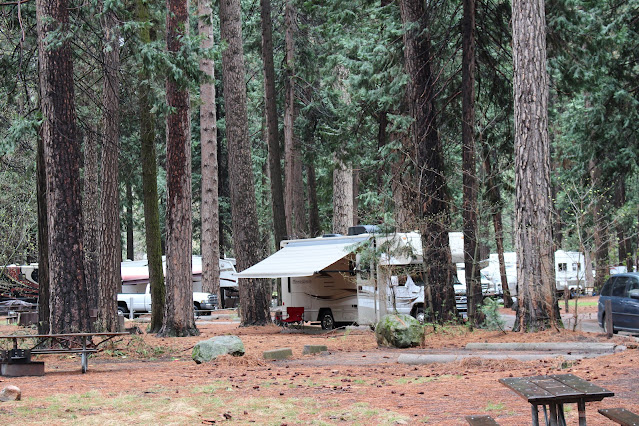
Although the campsite we had was nicely paved, it still required the use of leveling blocks. The campground itself was on a slight upslope. I was surprised to see so many trees in Trailer Village and we had good shade at our campsite. There were so many trees that I didn't need to use the awning and they prevented me from putting up the flagpole. Oh, well.

Occasionally, elk will stroll in or near Trailer Village. We saw one bull elk about 50 yards from our campsite.

Above, "Mr. Elk" near our campsite. Photo by Armand Vaquer.

Unless you are lucky to get an end campsite (as we were) with more room, the sites are somewhat close to each other.

Above, the Trailer Village check-in office. Photo by Armand Vaquer.

The Blue Line Shuttle has a stop at the main entrance to Trailer Village, which is nice and handy for going into Grand Canyon Village or transferring to other shuttle lines to visit viewpoints along the canyon rim.

Above, the shuttle stop at Trailer Village's entrance. Photo by Armand Vaquer.

If I go to Grand Canyon National Park again (as I probably eventually will), I would stay at Trailer Village again.

My grade: A.

Sunday, November 12, 2017

Grand Canyon Hermit's Rest

Above, a view of Grand Canyon Village from one of the viewpoints along the Hermit's Rest route. Photo by Armand Vaquer.

On the second day in Grand Canyon National Park, Jes and I took the Hermit's Rest shuttle to the viewpoints along its route.

Above, the main shuttle center near the Visitor Center. Photo by Armand Vaquer.

To get to the Hermit's Rest shuttle, one must take a Blue Line shuttle to a transfer stop west of Grand Canyon Village to take the Red Line Shuttle. Except for the Red Line, the other shuttles can be boarded at the main shuttle stop near the Visitor Center in Grand Canyon Village.

Along the way, the Red Line Shuttle stops include Rim Trail, Powell Memorial, Mohave Point, The Abyss, Pima Point and Hermit's Rest (along with trails).

Here's some photos from the Hermit's Rest route:

Above, a view of the Colorado River. Photo by Armand Vaquer.

Above, hikers on a trail below Grand Canyon Village. Photo by Armand Vaquer.

Above, a view of the Colorado River from Pima Point. Photo by Armand Vaquer.

Above, a weathered tree. Photo by Armand Vaquer.

Above, the arch at the Hermit's Rest entrance. Photo by Armand Vaquer.

Above, the Hermit's Rest gift shop and snack bar. Photo by Armand Vaquer.

Above, the hearth inside the Hermit's Rest gift shop. Photo by Armand Vaquer.

Above, Jes and I at Hermit's Rest. Photo by Armand Vaquer.

Made It To The Grand Canyon

Above, a view of the canyon from Yaki Point. Photo by Armand Vaquer.

After a night's stay at the Meteor Crater RV Park near Winslow, Arizona, we pressed ahead to Grand Canyon National Park for a two night's stay at the park's Trailer Village. This was the first time I've stayed at Trailer Village.

Above, the check-in station for Trailer Village. Photo by Armand Vaquer.

Contrary to some postings at a few RV-oriented forums, the Trailer Village looked as though it was paved fairly recently, so there were no potholes to plague RV campers.

It was a nice campground with full hook-ups for $45.00 a night. We got lucky and got an end site with more room.

Above, the shuttle stop at Trailer Village. Photo by Armand Vaquer.

After setting up camp, Jess (who came along on the trip) and I took the Orange shuttle bus to viewpoints including Yaki Point, Pipe Creek Vista and Mather Point. Like the shuttles at Yosemite National Park, one needn't use their own vehicle (many of the roads don't allow them anyway) to get around. It is handy to use and it does cut down the amount of vehicle traffic.

Above, the campsite. Photo by Armand Vaquer.

After taking the tour, a barbecued steak dinner at camp was enjoyed.

The next morning, the camp was treated by a nearby stroll by a bull elk.

Above, a bull elk strolls near our campsite. Photo by Armand Vaquer.

The next day, we took the tour (Red Line) to Hermit's Rest. That will be covered in anothe blog post.

Saturday, August 12, 2017

Yellowstone Traffic Problem May Force Changes

Above, a mother bear and her two cubs caused a "wildlife jam" during one of our Yellowstone tours. Photo by Armand Vaquer.

When my daughter and I visited Yellowstone National Park two years ago, our park visits consisted of two tours and one early-morning drive-through to get to Grand Teton National Park on our way home. We got to see more of the park during the tours than we would have if we drove ourselves in The Beast, and without the headaches of driving.

A new study reveals that the average visitor spends 60 to 80 percent of their time in Yellowstone behind other vehicles. This may prompt a change.

Condé Nast Traveler has posted an article on this problem.

They begin with:
When visitors roaming Yellowstone National Park in cars see a grizzly bear and her cubs, or a herd of bison, they stop. And so do the cars behind them, every window open as cameras lurch to get that perfect shot. The National Park Service (NPS) calls these stoppages "wildlife jams," and a new NPS report reveals each one results in a 30- to 120-minute traffic backup. The study, one of two released Thursday, examines the way swelling crowds, especially during peak season, threaten not only the environment, but the visitor experience, and come to a bleak conclusion: In July, the roadways near popular attractions such as Old Faithful are 29 percent over capacity, and if action isn't taken, the entire park could hit its traffic capacity in just four to six years. If nothing changes, and visitor numbers increase with current year-over-year trends, it could lead to backups at popular sites and unsustainable degradation to the road system and the natural environment.
Above one of the tour buses we took with a private tour company to see Yellowstone. Photo by Armand Vaquer.

Possible changes may include shuttle buses and reservation systems.

To read more, go here

Search This Blog