Hitachi VHS Karaoke

Buy The Amazon Kindle Store Ebook Edition

Get the ebook edition here! (Click image.)
Showing posts with label VHS. Show all posts
Showing posts with label VHS. Show all posts
Monday, February 10, 2025

Monday, October 21, 2019
Criterion's Peter Becker Discusses Godzilla Showa-Era Release
 |
| Above, Godzilla approaching Tokyo's Kachidoki Bridge in 1954. |
Godzilla fans over the years have collected the King of the Monsters's movies ever since VHS tapes were made cheaply available.
Some were official releases and others were bootlegs (at one time, the only way to see the Heisei Series (second series) of Godzilla films was through the bootleg market.
Then came DVD and Blu-ray discs which offered the movies in high resolution. Some releases were better than others (a lot of it depended upon the original source material). Again, fans bought and re-bought the movies.
Now, Criterion Collection is releasing the Showa Series (first series) of Godzilla movies in a new box set. Here we go again!
Criterion Collection's Peter Becker discusses the Godzilla release in a Variety article.
Here's a snippet:
He added: “The idea basically is that it would be wrong to treat Bergman the same way as we treat Godzilla, but it would also in some ways be wrong to treat Godzilla with any less respect than we treat Bergman with.”
Criterion last year released its “Ingmar Bergman’s Cinema” Blu-ray disc box featuring 39 films and a book featuring critical essays on each of the films.
Its new “Godzilla: The Showa-Era Films, 1954-1975” collection, which comprises 15 digitally restored films and a book featuring newly commissioned illustrations by high-profile artists, is scheduled for release Oct. 29.
Becker stressed that publishing was not just about bringing products into the world but rather “about how you’re putting it into the world. What it looks like, what it feels like. Even just the finish on “Godzilla” feels a little bit like skin, it’s nice. It’s little details like that that you need to pay attention to – those are all part of publishing.”The fanbase again will be shelling out hard-earned cash. Since Criterion puts out quality videos, it is likely to be worth it.
To read more, go here.
Tuesday, April 11, 2017
Scored At Amoeba Music
 |
| Above, House of Dark Shadows VHS signed by Jonathan Frid and Kathryn Leigh Scott. Photo by Armand Vaquer. |
Much of today was spent down in Hollywood with my cousin Ralph.
Before heading to Hollywood, we stopped at Vip's cafe in Tarzana for breakfast.
Following breakfast, we then headed to Amoeba Music on Sunset Blvd. Amoeba Music is a huge store that sells new and used CDs, DVDs, vinyl records and other items of entertainment.
I managed to pick up the last two Clint Eastwood Dirty Harry movies: Sudden Impact (1983) and The Dead Pool (1988). I already have both movies on VHS, but with a price tag of $2.99 each, I figured I'd get them.
But, for me, the buy of the day was a VHS copy of House of Dark Shadows (1970). I already have it on Blu-ray, but the VHS tape Amoeba Music had for sale was autographed by Jonathan Frid (Barnabas Collins) and Kathryn Leigh Scott (Maggie Evans). The price of the tape was lower than what one would expect to pay just for an autograph at a convention. Plus, it can now be considered a "rare" collectible since Jonathan Frid passed away a few years ago.
Ralph picked up a poster and several CDs.
I am very pleased with my purchases.
Thursday, January 23, 2014
Forbes Contributor Predicts "Godzilla" Flop
 |
| Above, the Hibiya Godzilla statue. Photo by Armand Vaquer. |
It may happen, and it may not.
John Furrier, a contributor to Forbes.com, predicts that the upcoming Legenday Pictures/Warner Bros. Godzilla will be a box office flop. He named it as number one of three big Hollywood productions that will be flops in 2014.
On Godzilla, he wrote:
Following are our predictions and analysis for the Top Three biggest flops of 2014, in order of magnitude (net loss):Furrier neglects to factor the 1985 dollars and adjust them to inflation when it comes to Godzilla 1985. Plus, the studio who produced and distributed it paid relatively a paltry sum. So, $4 million in 1985 dollars was not that bad a return.
1)Godzilla. Hands down, “Godzilla” will be the biggest box office bomb of 2014. Godzilla as a character is box office poison. The fact is the last 3 Godzilla movies released domestically have flopped: “Godzilla 1985” made $4M; “Godzilla 2000” made a whopping $10M and the last attempt at a Hollywood-style big budget remake, also called “Godzilla” bombed so bad that its lead toy licensee went bankrupt. Had the movie made a profit the studio wouldn’t have just let the rights expire in 2003 without even attempting a reboot or sequel. They had 5 years to make a new film based on this property yet they passed. Think about it—Sony, the studio that greenlights sequels to most anything—”Resident Evil 6″ is on the horizon and don’t forget about “Underworld 5″—walked away from investing another cent in Godzilla.
On Godzilla 2000, the movie was poorly marketed and many people thought it was a sequel to the 1998 Matthew Broderick disaster, which, by the way, deserved to flop. It didn't look like Godzilla or act like Godzilla. Additionally, he fails to mention that both Godzilla (1998) and Godzilla 2000 made money in the home video (VHS, DVD) market. (Godzilla 1985 is currently in limbo as far as home video rights are concerned.)
So far, Legendary Pictures and Warner Bros. seem to be doing everything right this time. Whether this translates to "more butts in seats" remains to be seen. The fan buzz on the movie has been very positive. That's another thing Furrier neglected to consider. Godzilla has a fan base (although not as big as the Star Wars or Star Trek fan bases) that will drum up more positive buzz should the movie meet their expectations. Good word-of-mouth is something that cannot be ignored.
To read the full article (Furrier does have more to say on Godzilla), go here.
Friday, September 9, 2011
PRESERVING GODZILLA
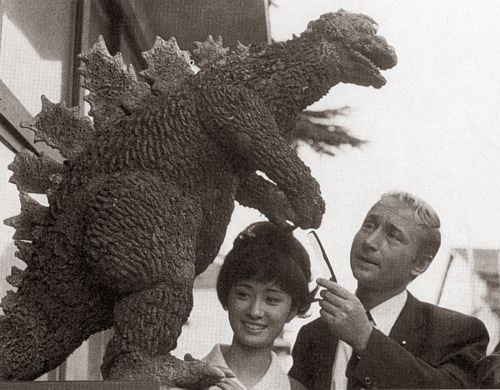
Ten years ago, I wrote the following article on Toho's efforts to preserve their film library of kaiju movies for G-FAN magazine (issue no. 48). I thought now would be a good time for a revisit.
by Armand Vaquer
Do you wonder if Godzilla will be around for future generations to enjoy? This thought occurred to me when I set out to check on the state of Toho’s classic Godzilla films and what efforts are being made to ensure that the “King of the Monsters” will be around for generations to come.
I recently checked on the subject of film preservation and restoration with the American Film Institute (AFI) and found that our film heritage is in pretty good shape, at least for now. The thought also occurred to me, “ What is being done in Japan by Toho Co., Ltd. in preventing film deterioration?” I will state my findings herein.
Background.
As many of you motion picture fans know, film deterioration has been a major concern during the past several years. Many studios and the American Film Institute have in place programs to restore, preserve and protect films of varying ages and film types.
Several years ago, concern was raised over the loss of films before 1951 that were on nitrate-based film stock. Nitrate film stock turned out to be unstable, flammable and deteriorates after several years. When it was realized that we were losing our old films, efforts began to transfer these films from nitrate stock to modern safety film. Thanks to these efforts, older nitrate films were saved and not lost to the ages as some had already been.
Another concern was that color films were deteriorating (even though they were on safety film) because of the single strip film emulsion also proved to be unstable. It has been learned from bitter experience that unlike the earlier three-strip Technicolor film process, today’s color film can fade irretrievably in as little as five years (note that Lucasfilm had to restore the earlier “Star Wars” films before they could be re-released just prior to the release of “The Phantom Menace”).
According to the AFI, “There is no practical solution for preserving the color in single-strip emulsion safety film.”
Then there’s also “The Vinegar Syndrome.” Modern safety film bases are composed of either acetyl cellulose (triacetate) or polyester (product names “Estar” or “Cronar”). When exposed to flame, modern safety film will only curl and extinguish itself. When modern safety film is properly stored, it should not decompose over time and is estimated to have a shelf life about as long as that of good quality paper, approximately 200 to 300 years. Shrinkage and brittleness will also be minimized in films that are properly stored.
However, during the past several years, archivists and technical experts have learned that triacetate film is not always as stable as was originally thought. Acetate degradation has been identified as a new and potentially serious problem for preservationists. Commonly referred to as “the vinegar syndrome” (because of a vinegar-like odor is given off by deteriorating acetate), acetate degradation proceeds in a way not dissimilar to nitrate deterioration, but without the flammability factor. This problem has proven to be especially serious in films improperly stored in high temperature and humidity environments. It is also believed to be contagious, that degrading acetate can infect other films stored in the same area.
Toho’s film library.
Fortunately for us kaijulogists, although there had been kaiju eiga films ("Godzilla", 1954 and "Godzilla Raids Again", 1955) made with nitrate-based film stock, Toho had transferred all original nitrate films to non-flammable safety film. Therefore, no Toho Co., Ltd. kaiju films have been lost due to nitrate deterioration. Like the United States film industry, the Japanese film industry ceased using nitrate-based film stock and started using safety film in the late 1950s.
What of the Godzilla color films? Toho reports that they have the original negatives/master materials of their kaiju eiga films in their best possible conditions. Toho has been aware of the “vinegar syndrome” and has been paying due attention to temperature/humidity control of their film vaults. This has been perfected by Toho’s introduction of their new storage facility for original negatives with a more advanced temperature and humidity control system, called PPM Centre, three years ago.
According to Stuart Galbraith’s book, “Monsters Are Attacking Tokyo!,” Toho primarily used Eastman Color for their color kaiju eiga films. So it appears that the three-strip Technicolor process was never used for their films. U.S. releases of some films ("King Kong vs. Godzilla" (1963) for example) were printed in Technicolor.
On the video and DVD road.
The advent of home video (originally in Beta and VHS formats) in the 1980s allowed Godzilla fans to collect their favorite kaiju films. Often these mass-produced videos had picture qualities that varied as much as the designs of Toho’s monsters. Everyone is pretty much in agreement that the video quality depended upon the original source material.
For example, some companies (Simitar, for one) released video tapes of the classic (or Showa) Godzilla films and often the film prints used left much to be desired. It was through either indifference or economy that this is the case. Many of the video tapes that I have purchased had faded images, choppy editing or horrible sound. Then there are other video distributors who had an excellent print to work with and therefore produced a fine video. Some companies issued videos in EP (extended play) speed that would accentuate an already bad print.
With the introduction of digital DVD in the 1990s, kaiju collectors are able to enjoy superior video and sound on their players. Most, if not all, Heisei series Godzilla films are starting to be released in DVD. This allows for a superior product to be produced before film deterioration to sets in. [Note: Godzilla movies are now starting to be released on Blu-ray. - A.]
At present, there are no programs at Toho to restore their older kaiju films a la Lucasfilm and others. This may be due to the costs involved (in the U.S., AFI reports that the cost to preserve color images can easily be $40,000 per feature-length film), the quality of negatives and storage facilities involved. I have a copy of “Godzilla vs. Ebirah” that has excellent color images, and that film is around 35 years old. I have also seen different prints of “King Kong vs. Godzilla” (1962) and each one had color images that looked as though the film was made this year or pretty close to it.
At present, according to AFI, the only cost-effective means of dealing with color fading is to slow it down by storing color films in vaults designed to maintain below-freezing temperatures and low humidity. This is a stopgap measure. While cold storage may prolong the life of color films, it cannot ensure their survival until the time when it may be possible to transfer the images to an archivally stable medium. It was hoped that digital archiving would accomplish this, but it appears that digital images may not be as perpetually stable as was originally thought or hoped for. The jury is still out on this aspect and it depends upon whom you talk to.
But for the short term at least, we can still enjoy vibrant images of Godzilla in his nearly five decade long adventures.
Sources: American Film Institute, Toho Co., Ltd. (L.A.) and “Monsters Are Attacking Tokyo!” by Stuart Galbraith IV.
©2000 Armand Vaquer
Wednesday, July 28, 2010
Club Tokyo: A Collectors' Database
 Above, a porcelain Godzilla figure (owned by yours truly). Is it listed at Club Tokyo?
Fans of any subject, genre or person tend to collect items associated with that particular passion. Godzilla (and kaiju) fans are no exception.
Some collect movie memorabilia such as posters, lobby cards and theater giveaways. Others will collect toys, action figures, VHS tapes, DVDs and other items.
There is one place where all Godzilla and kaiju collectors can get information on virtually all collectibles: Club Tokyo.
Club Tokyo is a website database in which all items are catalogued with a history of each item, including variants, are presented. It is overseen by Richard Cox, Mike Johnson and Bob Schneider.
Club Tokyo has been around since July 28, 1998 and it is constantly updated by Cox, Johnson and Schneider with the help from fan contributors. I've contributed a few items.
The site is broken down into different categories, such as figures, candy/capsule toys, theater exclusives, kits, prototypes, articles, paperwork, miscellaneous and reviews.
If there's been an item produced concerning Godzilla, Gamera or other kaiju, chances are it has been catalogued at Club Tokyo. If not, and you have the item, feel free to contribute the information on it!
So, if you are a collector of Godzilla and kaiju items, you will want to take a look at Club Tokyo. It is very easy to lose track of time while perusing it.
Their website is http://www.clubtokyo.org/
Wednesday, March 17, 2010
Get "Godzilla vs. Biollante" On Region 1 DVD

A fan-generated effort is now underway to get Walt Disney Studios Home Entertainment to release the 1989 feature, Godzilla vs. Biollante on DVD.
Godzilla vs. Biollante was the follow-up movie to 1984's Return of Godzilla (Godzilla 1985) in which Godzilla is released from the crater of Mt. Mihara on Oshima Island.
It is available on Regions 2 and 3, but not here in the United States (Region 1).
The idea is to saturate (as much as possible) the suits at Disney (who bought out Miramax and their film library) with cards and letters to get them to release Godzilla vs. Biollante on DVD. The movie was released on VHS video tape back in the 1990s, but it has not been released on DVD here. It is about like trying to listen to your favorite rock album on 8-track tape today.
So send your cards and letters to:
Walt Disney Studios Home Entertainment
500 South Buena Vista Street
Burbank, CA 91521
Please be polite and business-like when writing. You will catch more flies by using honey instead of vinegar!
Sunday, September 20, 2009
Classic Media's Blu-ray "Godzilla" Worth Getting?

DVD Talk.com reviewed Classic Media's new Blu-ray disc of the original Japanese version of Godzilla (Gojira) from 1954. They recommend a pass.
They wrote:
Classic Media's Blu-ray of Gojira is a major disappointment that can't really be recommended. The HD encoding is interlaced (1080i) instead of progressive (1080p), which leads us to suspect that the source is the same used on the earlier standard def release -- billed as mastered in "Native Hi-Def".
Every comparison with the existing Deluxe Collector's Edition DVD makes that release seem a better purchase option. That disc's variable contrast and odd ghosting issues that were undoubtedly in the tape element provided by Toho. The new Blu-ray looks identical except in the monster destruction scenes, which are timed much darker. Under these conditions the added resolution of HD adds nothing whatsoever to the visuals -- the Blu-ray looks like the standard DVD but with additional problems.
Personally, I haven't purchased a Blu-ray machine and I really am not compelled to do so anyway. Standard DVD is just fine as far as I am concerned. Who needs to see every pore or blemish on an actor's face anyway? I resisted going into the DVD format at the beginning as I really didn't want to bother going into another video format from VHS tape. But, as time went on, releases on VHS became fewer and fewer and colleagues urged that I switch. I bit the bullet and bought a DVD player. In retrospect, it was a wise decision as there are now virtually no VHS releases. If Blu-ray becomes "the standard" for home video as DVD did, then I would be forced into jumping in, but kicking and screaming.
I have Classic Media's DVD set of the Japanese and American versions of Godzilla along with a Region 2 DVD that I purchased in Japan at the "Since Godzilla" exhibit in Koriyama during G-TOUR. The Region 2 version is much cleaner than Classic Media's DVD. I am satisfied with them.
On the other hand, I am hearing that Toho remastered their Godzilla movies in HD and their Blu-ray Godzilla completely blows Classic Media's right out of the water. One nice thing about Blu-ray, so I'm told, is that Japanese Blu-rays have the same region coding as American's. The only drawback is a lack of English subtitles.
To read DVD Talk's full review, go here.
Subscribe to:
Posts (Atom)