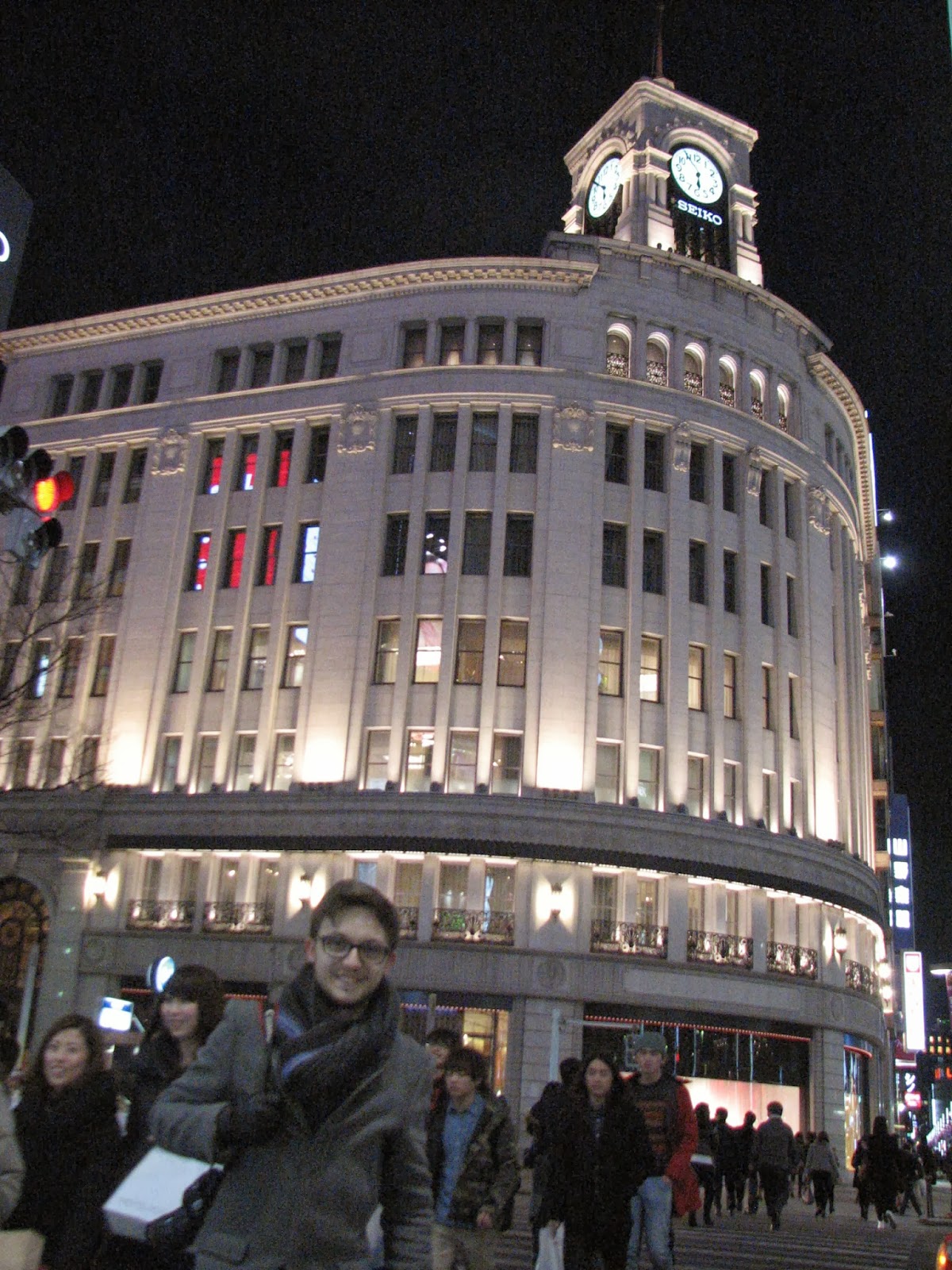
"There is no limit to what a man can do or where he can go if he doesn't mind who gets the credit." - President Ronald Reagan.

Buy The Amazon Kindle Store Ebook Edition

Buy The Amazon Kindle Store Ebook Edition
Get the ebook edition here! (Click image.)
Showing posts with label Yurakucho Mullion. Show all posts

Friday, December 8, 2023

Nichigeki Theater Re-Created In "Godzilla Minus One"

People have been raving about the special effects of Godzilla Minus One, but there's one thing that impressed me about the movie: the re-creation of 1940s Tokyo.

Sharp eyes will note the re-creation of the Nippon Gekjo Theater, more commonly known as the Nichigeki Theater. It was located in the Chiyoda-ku ward near Ginza.

Above, the Nichigeki Theater. 

The theater was demolished in 1981 for redevelopment and the Yuracucho Mullion building complex (it was featured and clawed by Godzilla in Return of Godzilla (1984)) now occupies the location. The theater was hit by Godzilla's tail in Godzilla (1954).

Above, the Yurakucho Mullion building. Photo by Armand Vaquer.

The Yurakucho Mullion building is covered in The Monster Movie Fan's Guide To Japan by yours truly.

For more on the Nichigeki Theater, go here.

Thursday, November 17, 2022

16 Years Since "Gamera The Brave"

Above, the Yurakucho Mullion Building. Photo by Armand Vaquer.

When the news came out overnight that the daikaiju Gamera is returning in Gamera; Rebirth, courtesy of Kadokawa Pictures and Netflix, it reminded me that it has been 16 years since the last Gamera movie was produced.

I planned a trip to Japan in April 2006 and it just so happened that the premiere of Gamera The Brave (a.k.a. Gamera: The Little Braves) would have its premiere at the same time. The premiere was held at the Marunouchi Piccadilly theaters in Tokyo in the Yurakucho Mullion Building. (The Yurakucho Mullion Building was trashed by Godzilla in Return of Godzilla (1984), by the way.)

Above, yours truly at the souvenir table at the Gamera The
 Brave premiere in Tokyo from a Kadokawa DVD video.

That was the Japan trip in which I visited Sendai and Matsushima to see where my dad was briefly stationed before being sent to Korea. 

At the premiere, the stars and director appeared onstage and addressed the audience that included yours truly, following my excursion to Sendai and Matsushima.

Above, Gamera The Brave tickets.

Even though I don't speak Japanese and Gamera The Brave wasn't subtitled, I still enjoyed it. At the time, it was hoped that Gamera The Brave would usher in a new series of Gamera movies, but that didn't happen. 

The following summer, Gamera The Brave was premiered at the Pickwick Theater in Park Ridge, Illinois as part of G-FEST XIII. 

Wednesday, April 11, 2018

It's Been A While


Above, my tickets to the 2006 Tokyo premiere.

Earlier this afternoon, I was rummaging around my collection of music CDs and came across one by singer Mink (stands for Made In Korea) that was part of the soundtrack for 2006's Gamera The Brave.

That was the last Gamera movie made by Kadokawa Pictures (the successor to Daiei). I attended its premiere at the Yurakucho Mullion in Tokyo on April 29, 2006 and wound up in the Japanese DVD in footage from the premiere in the extras. I am seen at the doorway to the theater and later at the souvenir stand (I got my mom a small Gamera plush key ring that now hangs on the rear-view mirror of my RV). It was an enjoyable event as was the movie, even though I don't understand Japanese and there were no subtitles.

Above, Gamera souvenirs for sale at the premiere. Photo by Armand Vaquer.

After playing the CD, I decided to pop in the DVD of Gamera The Brave and watched it over dinner, since I haven't watched it in years (I have no idea of when).

It is an enjoyable monster movie with beautiful cinematography and acting. It is a stand-alone film and not a sequel to the Gamera trilogy directed by Shusuke Kaneko of the 1990s. It is really too bad that Kadokawa didn't press on with any sequels to Gamera The Brave. Apparently, the box-office take wasn't sufficient enough to warrant making any more.

Above, at the 2006 Tokyo premiere, from the Japanese DVD.

Anyway, it was enjoyable to watch Gamera The Brave after so many years. It is hard to believe that twelve years have passed since the premiere.

Saturday, August 29, 2015

Ginza To Get Airport-Style Duty-Free Shops

Above, a department store at the Yurakucho Mullion. Photo by Armand Vaquer.

Foreign visitors to Japan who want to go on shopping sprees in Tokyo, but don't want to be taxed on their purchases, are in luck.

The Japan News (Yomiuri Shimbun) reported:
A series of new duty-free stores will open in Ginza, Tokyo, from this autumn to cater to the growing number of foreign customers coming to the shopping district. 
“Airport-style duty-free shops” — where not only the consumption tax, but also customs, alcohol and other taxes are waived — are scheduled to open for the first time in Tokyo. An influx of foreign visitors has brought a change of mood to Japan’s renowned shopping district, and progress has been made to create a place that will entertain both foreign and Japanese visitors.
To read more, go here

Wednesday, August 19, 2015

Record 1.91 Million Foreign Tourists Visited Japan In July

Above, the Yurakucho Mullion. Photo by Armand Vaquer.

Japan is en route in a big way to reaching their goal of 20 million foreign visitors by 2020 (when they host the Summer Olympic Games in Tokyo).

According to the Japan Times:
The number of foreign passenger arrivals in Japan reached 1,918,400 in July, the highest monthly total on record and a 51.0 percent surge from a year earlier, government data showed Wednesday. 
The total at the start of the summer vacation season surpassed the previous monthly record high of 1,764,691 set in April, according to the Japan National Tourism Organization. 
Meanwhile, a record 11.05 million foreigners are estimated to have visited Japan from January to July, up 46.9 percent from the same period last year, moving closer to the annual goal of 20 million that the government seeks to achieve by 2020 when Tokyo will host the Olympics and Paralympics.
To read more, go here

Thursday, February 12, 2015

4Hoteliers: Focus On Tokyo

Above, a view looking towards the Yurakucho Mullion and Ginza from Hibiya. Photo by Armand Vaquer.

4Hoteliers.com has posted some interesting foreign visitor statistics on Tokyo, Japan.

They begin their article with:
With a population of just over 13 million people, and one of the world’s highest population densities, Tokyo is known as a city creative in adapting and reusing space;  
As the political and financial capital of Japan and a global financial centre, Tokyo has received much attention from domestic and foreign investors looking for opportunistic investments or a first step into the market. 
Tourists and hoteliers have benefitted from currency shifts and economic swings, though with the country once again officially in recession it remains to be seen how long the spotlight will last. This article features the city’s tourism climate and trading performance of luxury hotels, as well as the future looking forward.
 To read the article, go here.

Sunday, January 25, 2015

Tokyo Daily Life's "Summary of Yurakucho"

Above, the Yurakucho Mullion. Photo by Armand Vaquer.

The areas of Hibiya, Yurakucho and Ginza is pretty familiar to Godzilla fans.

In 1954, Godzilla stomped through Ginza and demolished or torched the Wako Department Store at Ginza Crossing and the Matsuzakaya Department Store.

Hibiya is known as the place where the Godzilla statue stands on a pedestal in Hibiya Chanter Square.

Yurakucho is known as the location of the Yurakucho Mullion buildings where the Toho Nichigeki Theater once stood (it was also demolished by Godzilla in 1954 as an "inside" joke). This means that Godzilla made an appearance in Yurakucho.

But there is more to Yurakucho than just the Yurakucho Mullion. There are stores, bars and restaurants galore jamb-packed in a small area. One of my favorite sushi restaurants (a revolving sushi restaurant) is just under the shinkansen tracks.

Tokyo Daily Life has posted an article (with plenty of photographs) of Yurakucho.

The article begins with:
Yurakucho is a shopping district adjacent to Marunouchi and Ginza. Going south on Naka Dori Street, you can reach there. You can enjoy contemporary and neat Tokyo, such as the Tokyo International Forum and the redeveloped buildings at the east side of Yurakucho station. There are commercial facilities that have the advantage of fashions at the east side of the station, such as Hankyu MEN'S TOKYO, LUMINE and MARUI. On the other hand, you can also enjoy miscellaneous and common Tokyo, such as Japanese taverns at an area called Gado-shita (below the girder) including Yakitori Alley. Yurakucho is a very interesting area where various aspects of Tokyo can be seen. By the way, the boundaries between Yurakucho and Marunouchi or Hibiya are indefinite, so I introduce the area along Naka Dori Street on an article of Marunouchi, and Nissay Theatre and the Imperial Hotel on an article of Hibiya.
 To read more, go here.

Thursday, October 2, 2014

Godzilla's Nichigeki Theater

Above, the shinkansen passes the Nichigeki Theater after leaving
Tokyo Station on December 21, 1964. Photo: Kyodo News/AP.

The above photo has been accompanying articles on the 50th anniversary of Japan's shinkansen (bullet train) in various news outlets.

The photo was taken on December 21, 1964, two months after the shinkansens were put into service. The first shinkansens ran from Tokyo to Osaka.

The Toho Nichigeki Theater in Yurakucho (sandwiched in-between Ginza and Hibiya) is familiar to Godzilla fans. It was featured in the 1954 Godzilla as sort of an inside joke for theater patrons who were sitting in that very theater screening Godzilla. In the movie, Godzilla steps on the nearby train tracks. The electricity from the tracks course through Godzilla (it must've tickled him), causing his tail to whip around and smashing the theater building.

Above, Godzilla approaches the Nichigeki Theater in 1954.

The theater was later demolished (for real, this time) and the site is now occupied by the Yurakucho Mullion Building (featured in Return of Godzilla in 1984).

The Ginza-Hibiya areas of Tokyo are spotlighted in The Monster Movie Fan's Guide To Japan on page 28.

Monday, July 7, 2014

L.A. To Tokyo Price Update

Above, the ground floor of the Yurakucho Mullion Building. Photo by Armand Vaquer.

This'll be a brief and less-detailed report on Los Angeles to Tokyo airfares.

As I wrote last week, the Los Angeles Times Travel section found the lowest airfares to Tokyo to be $1,154.00 on the low end and the high end to be $1,740.00. These, of course, do not include any taxes or fees.

I said last week that unless there's a change from last week's report, the next fare check report would be the August one. Well, there has been a change, but at least it is a good one. The Times reported that the price range they found was $1,104.00 on the low end and $1,691.00 on the high end. Again, these are before any taxes or fees added.

At least the prices were lower than last week's, and lower prices are always good for the consumer.

Unless the prices make a major change, the next report will be next month's.

Sunday, July 6, 2014

Getting Toho Cinemas Discount Tickets

Above, a giant movie poster at the Yurakucho Mullion. Photo by Armand Vaquer.

There have been three occasions where I screened a movie in Tokyo.

The first time was when Godzilla, Mothra and King Ghidorah: Giant Monsters All-out Attack premiered at the 2001 Tokyo International Film Festival at Orchard Hall in Shibuya's Bunkamura. The second time was in 2006 when Gamera The Brave (listed on the ticket as Gamera: The Little Braves) premiered at the Marunouchi Piccadilly Theaters in the Yurakucho Mullion. The third time was also in the Yurakucho Mullion at the Toho Cinemas Nichigeki for Space Battleship Yamato in 2010.

Going to a movie theater is a little different than going to one in the U.S. In Japan, I was able to pick out what seats I wanted and the row and seat number would then be printed on the ticket. I also noticed that ticket prices for movies in Japan were higher than in the U.S., around ¥1,800 (roughly $18.00).

Current ticket prices in the U.S., I've noticed, have also shot up to the $15.00-$18.00 range as well. But, cheaper tickets can be obtained by going to a daytime matinee screening where the prices are cut to about half.

Gaijinpot.com has a new article on getting discounted movie tickets. Their recommended theaters to see Hollywood movies are Toho Cinemas. They prefer Toho's theaters because "the digital picture and sound quality are top notch – so clear and crisp. The seats are clean, well-tiered, and extremely comfortable. Hollywood movies are shown in English with Japanese subtitles, so you don’t need to worry about awkward dubbing."

On getting discounted movie tickets, the article says:
Ticket prices start at 1,800 yen, but there are opportunities each month to watch movies at a discounted rate! The public can watch movies for 1,000 yen every first and fourteenth of each month. Women have additional benefits; every Wednesday is Lady’s Day for 1,000 yen.
To read the full article, with information on ordering tickets online from Toho Cinemas (which is a little tricky as some knowledge of Japanese is necessary), go here.

Wednesday, March 26, 2014

The Beat Diner Lives Again!

While going through my photographs of my February trip to Japan, I came upon one photo that I took of the closed-up front of the former location of The Beat Diner.

Above, this is what greeted me at the location of The Beat Diner under the shinkansen tracks. Photo by Armand Vaquer.

The Beat Diner was located under the shinkansen tracks that separate Ginza and Hibiya (the former location of Becker's) and across the street from the Yurakucho Mullion. I first tried out, and liked, The Beat Diner back in December 2010 and blogged about it here.

Above, part of the dining area of The Beat Diner adorned with classic album covers. Photo by Armand Vaquer.

After looking at the photo, I decided to do a search to see if there is anything online about the closure of The Beat Diner. My search located the website for The Beat Diner's parent company and found this page for The Beat Diner.

Above, The Beat Diner's bartender. Photo by Armand Vaquer.

As it is in Japanese (unfortunately, I don't read Japanese), I copied and pasted the information to Google Translate and it came up with this very rough translation:
Store a list of store results The Beat Diner ※ There is a case to change from period to period, such as year-end and New Year holidays.

Store name access business hours phone number Suica use Nihonbashi Mitsui Tower store
March 20 Open!
First floor Nihonbashi Mitsui Tower underground   11:00 to 23:00   03-3510-1238   
Top Store finder 

Please click on [Search] to select the station or brand you are looking for from the pull-down menu.
I am assuming from this (provided I am reading the rough translation right), The Beat Diner re-opened March 20 on the first floor of the Nihonbashi Mitsui Tower underground (subway?). If this is the case, it is good to know that there is still a place in Tokyo that serves great burgers and pizza (along with adult beverages) with classic rock 'n roll!

Well, as I was wrapping up this blog post, I received a confirmation email that said, "It says it has re-opened at Mitsui Tower in Nihonbashi on 20 March."

That's great to know!

Thursday, February 13, 2014

Busy Day of Running Around In Tokyo

Above, a view of the Skytree from its base. Photo by Armand Vaquer.

This was a busy day in Tokyo.

I started out the day by going over to the new Tokyo Skytree. It appears that the crowds have died down (although there were many people there) and getting a ticket to go up to the observation deck is easier. I would have gone up (for about ¥2,000), but I was pressed for time as I had a lunch appointment with former Toho-L.A. General Manager Masaharu Ina in Hibiya.

I got to the Ginza-Hibiya area 40 minutes early, so I thought I'd stop by The Beat Diner for something to drink. Unfortunately, I found that they went out of business. I ended up going to a nearby Starbucks. That location (under the shinkansen tracks) must not be too lucky for food establishments. First, Becker's went under, and now The Beat Diner.

Above, this is what I found when I went to The Beat Diner. Photo by Armand Vaquer.

Following lunch, I headed back to the hotel to see if Jonathan Bellés wanted to go see some Godzilla-related places. He did.

I earlier suggested to Jonathan Bellés that we go to the Lucky Dragon No. 5 exhibit at 2:30 PM. However, he wanted to sleep a little longer (I can't blame him, he worked his butt off with yesterday's interviews) and meet up at 3:30.

Above, the Wako and Mitsukoshi Dept. stores. Photo by Armand Vaquer.

Unfortunately, when we got to the Lucky Dragon, we found that it closed at 4:00 (a half-hour before we got there). Had we went at 2:30 as I suggested, we would have been able to go in and see it. I kidded Bellés, "We have a saying in America: "You snooze, you lose!""

Above, the former Matsuzakaya Dept. Store building is being re-done (the
blank building with the 2 blue stripes, center-left). Photo by Armand Vaquer.

Following this, we headed to Hibiya and Ginza so that Bellés could photograph the Godzilla statue in Hibiya and see some landmarks from Godzilla. He photographed the statue from all angles and when he completed his picture-taking, I snapped a few of him with the statue.

Above, Jonathan Bellés snapping photos of the Godzilla statue in Hibiya. Photo by Armand Vaquer.

Then, we talked towards Ginza. Along the way, I pointed out some Godzilla-related landmarks, including the Yurakucho Mullion Building, the Wako Dept. Store and the former Matsuzakaya Dept. Store.

Above, Jonathan Bellés and the Wako Dept. Store. Photo by Armand Vaquer.

We then headed back to our hotel, but paid a visit to the local McDonalds for some dinner. After dinner, we returned to the hotel and our respective rooms.

Friday, January 3, 2014

The Travel Daily Picks Up "Godzilla On Harumi-Dori" Post

Above, the old Nichigeki Theater once stood on the property
where the Yurakucho Mullion Building now stands at Harumi-Dori.


The Travel Daily online newspaper picked up the blog post of "Godzilla On Harumi-Dori." They jumped on that quick as I posted it about six hours ago in the wee hours of the night.

It is located in their Art & Entertainment section.

To view it, go here.


Yurakucho Fire Interrupts Shinkansen Service

Above, the Yurakucho Mullion Building. Photo by Armand Vaquer.

Speaking of the Yurakucho Mullion Building (two blog posts ago), a fire near the building broke out early today interrupting bullet train (shinkansen) service.

According to News On Japan:
The fire broke out in the early hours of Friday in a building near JR Yurakucho Station and spread to three other buildings nearby, according to East Japan Railway Co. and Central Japan Railway Co. 
To read the News On Japan article, which includes a news video of the fire (you can see the Yurakucho Mullion Building right next to the building that's on fire), go here.


Godzilla On Harumi-Dori

This photo from Return of Godzilla (a.k.a. Godzilla) (1984) is circulating around on Twitter. Godzilla is seen at the shinkansen tracks on Harumi-Dori that divides Hibiya and Ginza in Tokyo.


A different photo of Godzilla had been floating around and I posted it here. In that photo, Godzilla was approaching the Yurakucho Mullion Building. With that photo, I included a shot of the real Harumi-Dori and the Yurakucho Mullion Building that I took on a previous trip to Tokyo.

Here it is again:


This location/landmark is covered in The Monster Movie Fan's Guide To Japan on page 28.


Thursday, December 5, 2013

Impressive Japanese Clocks

Above, the Cosmo Clock 21 in Yokohama. Photo by Armand Vaquer.

One of the best characteristics of the Japanese people is their penchant for punctuality. Perhaps this characteristic is the reason why they have such impressive clocks.

The three Japanese clocks that are the most impressive I've seen are the Cosmo World Ferris Wheel digital clock in Yokohama, the clock tower of the Wako Department Store in Ginza and the Seiko clock at the Yurakucho Mullion in Tokyo.

The Cosmo World Ferris Wheel was once the world's biggest Ferris Wheel. While the Ferris Wheel is no longer the world's biggest, the Cosmo Clock 21 on it is the world's largest clock at 369 feet tall. The Ferris Wheel and clock were demolished during a battle between Godzilla, Mothra and Battra in Godzilla vs. Mothra (1992).

Above, the Wako Dept. Store's clock tower in Ginza. Photo by Armand Vaquer.

The Wako Department Store's clock is not the world's biggest or anywhere close to it, but it is iconic in that it is a well-known landmark in Tokyo. It is also iconic as it was featured, and demolished by Godzilla, in Godzilla (1954).

Above, the Yurakucho Mullion clock next to a "Space Battleship Yamato" poster. Photo by Armand Vaquer.

The clock at the Yurakucho Mullion Building in Tokyo isn't the biggest either, but it is impressive as it opens up every half hour and animatronic dancing dolls come out to provide passersby musical shows. The clock is a favorite meeting place for people in the Ginza-Hibiya-Yurakucho area.

Although the Yurakucho Mullion Building was featured (and damaged) in Return of Godzilla (1984), the clock did not make an appearance in the movie.

All three locations/landmarks are covered in The Monster Movie Fan's Guide To Japan.

Wednesday, November 20, 2013

Japan Tourism Hits Record Of Over 8 Million

Above, the ground level arcade of the Yurakucho Mullion.  Photo by Armand Vaquer.

Japan is creeping towards its goal of 10 million annual foreign visitors.

News On Japan reported:
The Japan National Tourism Organization says the number of foreign visitors to the country from January to October hit a record high of over 8 million. 
The agency estimates that the number of foreigners visiting Japan last month came to 928,500. 
The figure pushed up the 10-month total to nearly 8.7 million. The previous high of 8.6 million was posted in 2010. 
To read more, go here.

Tuesday, November 19, 2013

New "Space Battleship Yamato" Relaunched With 'Idealized Nationalism'

Above, the giant poster for the 2010 motion picture version at the Yurakucho Mullion.  Photo by Armand Vaquer.

It's baaaaaaack! (Not that it really ever left.)

The Asahi Shimbun's AJW (Asia & Japan Watch) reports that Space Battleship Yamato has been relaunched with hints of a new sense of idealized nationalism.

According to the article:
No matter how many times it sinks, the space warship Yamato is always resurrected by the hopes of those seeking the ideal Japan. 
The latest TV series in the “Space Battleship Yamato” franchise, which started in April and ended in September, retained that theme. But it also followed another idea that some say is the reason the anime is so popular. 
“Space Battleship Yamato 2199,” or “Star Blazers 2199,” hit the small screen 33 years after the original “Space Battleship Yamato” animated series about the vessel modeled after the Imperial Japanese Navy warship of the same name. A film version combining the latest TV series is now being produced. 
The original “Yamato” is called the pioneer of the anime boom that resulted in developing TV cartoons for children into a full-fledged anime industry. It also spawned records, books and other related merchandise. 
Film critic Tomohiro Machiyama says the “idealized nationalism” behind the story is one reason the animated franchise captured the hearts of Japanese.
During my last trip to Japan in December 2010, I attended a screening of Space Battleship Yamato (2010) at the Toho Cinemas Nichigeki in the Yurakucho Mullion Building. I found it entertaining with great special effects, although I understood hardly a word of it.

To read the full article, go here.

Tuesday, November 12, 2013

November LAX To Narita Airfare Price Check

Above, a view looking towards Ginza from the Yurakucho Mullion Building.  Photo by Armand Vaquer.

The summer vacation season has been over for almost two months, but one wouldn't know it from reading the Los Angeles Times Travel section when it comes to airfares to Tokyo's Narita International Airport.

In Sunday's edition, the airfares they came up with ranged from $1,171 to $1,359 from Los Angeles International Airport (LAX) to Narita International Airport (NRT). And, that's not even adding in taxes and fuel surcharge fees. These prices are what one would expect to be right smack in the middle of the summer vacation season, not when it is over and prices start dropping.

Regular readers of this blog know that for the past two times, I found round-trip airfares from LAX to Narita ridiculously lower than that the Los Angeles Times Travel section people came up with.

Let's see if I can do it again for the third time in a row (well, I've actually done it a lot more than two times, but the prices I obtained were much lower that I would ever expect).

Checking a GatewayLAX (which is my favorite source for flight tickets), here's what I came up with:


As you can see from above, I immediately found a much-cheaper round-trip airfare of $189, not counting taxes and fees. It amazes me why the Los Angeles Times can't seem to find cheaper fares. GatewayLAX was (or maybe still is) an advertiser to the paper, that's how I discovered them.

With prices like this one, plus the added bonus of getting more yen for your dollar these days, it is definitely worth your while to get off your couch and head over to Japan.

Monday, September 23, 2013

"Space Battleship Yamato" To Have Limited Theatrical Engagement Starting In October


Eleven Arts has announced that Space Battleship Yamato (2010) will have a limited theatrical engagement starting in October.

The movie will begin playing in Los Angeles and will make its way around the country in selected theaters.

I saw Space Battleship Yamato in December 2010 at the Toho Cinemas Nichigeki Theaters in the Yurakucho Mullion Building in Tokyo and have a subtitled copy on DVD.

Above, "Space Battleship Yamato" poster at the Yurakucho
Mullion Building in Tokyo.  Photo by Armand Vaquer.

About Eleven Arts:
ELEVEN ARTS, Inc. is a company dedicated to the sales and distribution of high quality films. Specializing in Japanese and Asian films, we serve as a bridge connecting films to audiences around the world. ELEVEN ARTS is expanding into the field of production, a move that will allow us to be more active in the pursuit of our goal of bringing great films to our audiences. We are based in Los Angeles.
If you haven't seen Space Battleship Yamato on the big screen, you're in for a treat!

For more, go here.

Search This Blog