"There is no limit to what a man can do or where he can go if he doesn't mind who gets the credit." - President Ronald Reagan.

Buy The Amazon Kindle Store Ebook Edition

Buy The Amazon Kindle Store Ebook Edition
Get the ebook edition here! (Click image.)
Showing posts with label Japanese. Show all posts

Thursday, June 25, 2026

Imported Japanese RV: 1998 Toyota Camroad Zil 4×4

Above, the Japanese motorhome I spotted in Asakusa. Photo by Armand Vaquer.

Some years ago, while roaming around the Asakusa section of Tokyo, I spotted a Japanese motorhome. 

It was parked in front of some shops. I took a couple of pictures of it. It was the first time I've ever seen a Japanese RV. 

RV Travel posted an article with video of a Japanese RV. It is a 1998 Toyota Camroad Zil 4 x 4. 

They started it with:

A lot of small campers promise clever packaging, but this one backs it up. The 1998 Toyota Camroad Zil by Vantech fits a full RV layout into a 16-foot body that still slips into a normal parking spot.

In the video at the end of this post, we get a tour from its owner, x90Dude.

It starts with a Toyota Dyna truck chassis, adds four-wheel drive, then tops it with a fiberglass camper shell from Japan. The result feels half mini truck, half tiny motorhome, and all of it has a ton of character.

Above, another view of the Japanese motorhome. Photo by Armand Vaquer.

To read more and see the video, go here.

Friday, December 19, 2025

The Shotguns of WWII: Model 1897 and Model 1912

Above, the Winchester Model 12 shotgun I bought last year. Photo by Armand Vaquer.

It is interesting that shotguns were very effective during World War II, especially in the Pacific Theater.

Winchester's Model 1897 and Model 1912 shotguns terrified Japanese soldiers, with good reason.

War History Online posted an interesting article on the use of shotguns during World War II.

They begin it with:

Aside from a flame thrower, there are few close-range weapons as deadly as a shotgun. Shotguns are terrifyingly effective at short ranges, as their shot spread does not need to be precisely aimed to score a hit. At longer ranges, a shotgun peppers the target with fast-moving metal balls, while at close ranges shotguns can effortlessly inflict horrific wounds. For these reasons, the shotgun has found itself at home in close quarters combat in wartime, sometimes controversially. Until the 1960s the United States’ shotguns of choice have been the Winchester Model 1897 and 1912.

Both of these shotguns started life as commercially-sold firearms but quickly proved themselves on the battlefield.

To read more, go here

Tuesday, September 30, 2025

Japanese Forces Stunned by the Power of 12-Gauge Shotguns!

 "Japanese Forces Stunned by the Power of 12-Gauge Shotguns!" by Voices of War.

Summary:

In the Pacific jungles of World War II, Japanese forces faced a weapon they never expected — the 12-gauge shotgun. What was meant for hunting turned into a devastating close-range battlefield equalizer.

Discover how U.S. Marines used raw stopping power, speed, and surprise to dominate close-quarters combat — leaving Japanese troops shocked and unprepared for the brutal effectiveness of this underrated weapon.


Tuesday, May 27, 2025

Miroku Winchester 94 Review (Video)

It is interesting that Miroku Corp. of Japan is licensed to manufacture Winchester rifles, such as the Winchester 94 lever-action. But the average Japanese citizen cannot own pistols or rifles. 

Japanese citizens are allowed to own shotguns for hunting and trap and skeet shooting. But, people have to go through a lengthy licensing process in order to do so.

It is said that Miroku's Winchester 94 rifles compare favorably to the pre-1964 Winchester 94s manufactured in the U.S. I have one made in 1962.

Here's a review video by Gun City:

Saturday, January 20, 2024

Sushi Night

Above, my order minus one salmon roll. Photo by Armand Vaquer.

For the first time in months (at least since last summer), I went to Zen Steak & Sushi in Gallup for dinner.

Last year, a new owner bought it and King Dragon (next door). I ate there once or twice since the takeover. I had been craving sushi and decided to go there this evening. They are still the only sushi restaurant in Gallup.

They had remodeled the sushi restaurant and it is renamed Harmony (or Pink Harmony). One of the restaurant crew members told me they remodeled it last October. The lighting is not dim like it was before. They no longer serve steak, by the way.

Above, the free cup of soup. Photo by Armand Vaquer.

I tried their salmon, tuna and yellowtail rolls. They were good. One added bonus: free soup with sushi.

I left the restaurant satiated. 

Thursday, December 14, 2023

Miroku Firearms Mfg. Co. of Japan


It is ironic that the Japanese company Miroku Firearms Mfg. Co. manufactures firearms such as the Winchester 94 lever-action rifle. But the average Japanese citizen cannot own handguns or rifles.

I have been to Japan eight times over the years and it was only recently I learned about Miroku.

According to the U.S. Department of Justice Office of Justice Programs:

Annotation

Japan's strict gun-control laws are unfair and oppressive; although some people assert that Japan's low crime rate is due to gun control, it is actually due to Japan's culture.

Abstract

Other than the police and the military, no one in Japan may purchase a handgun or a rifle. Hunters and target shooters may possess shotguns and airguns under strictly circumscribed conditions. The police check gun licensees' ammunition inventory to make sure there are no shells or pellets unaccounted for. 

Note: The above was published in 1992. However, nothing has changed since then.

From Miroku's website:

Miroku has come along with the history of Japan's hunting gun production.

The founding root of Miroku Firearms Mfg. Co. was 1893 (Meiji 26).

It is the starting point of the Miroku Group and is also the core of the gun business.

The country's No.1 hunting gun manufacturer "Miroku" started from here.

Their products have been praised by gun enthusiasts. They aren't cheap imported "Saturday night specials". 

Their product lines includes B.C. Miroku, Browning, Winchester and miroku OP.

To access the Miroku Firearms Mfg. Co. website, go here.

Sunday, November 5, 2023

Japanese Arisaka Rifle


This rifle is one I inherited from my dad. It didn't have any manufacturer's name on it. 

But, thanks to fellow members of Gun Owners of New Mexico on Facebook, it appears to be a sporterized Japanese Arisaka (possibly Type 38) rifle. I don't know what caliber it is. It could have been converted. 

The serial number has a beginning symbol (series marker) in kana and an ending symbol that indicates the arsenal it came from. My rifle has the symbol for Nagoya arsenal. 


Along with the folks on Facebook, this page at Old Military Markings confirmed this is a Japanese rifle. 

At least I now know a little more than when I started out.

Friday, August 18, 2023

Guide To L.A.'s Little Tokyo

Above, New Years Day Oshogatsu in Little Tokyo. Photo by Armand Vaquer.

During the last several years when I lived in Los Angeles, I would attend the Oshogatsu festival in the city's Little Tokyo district on New Year's Day.

I also wandered into the district for shopping or partaking in the district's restaurants. For kaiju fans, there are toy stores carrying Godzilla and other toys.

Above, former Assemblyman Paul Bannai and yours truly at the 2014 Oshogatsu.

When I worked for Assemblyman Paul Bannai back in the 1970s, we had events at the New Otani Hotel (now the DoubleTree by Hilton). My first visit was with my Asian Studies class during my senior year at Hawthorne High School.

Little Tokyo is one of the few things I miss since I moved to New Mexico.

AFAR has posted a guide to visiting Little Tokyo that should be useful for visitors.

It begins with:

Little Bangladesh, Thai Town, Little Armenia, Koreatown, Little Ethiopia, Tehrangeles, Historic Filipinotown—if there’s a culture you want to explore, chances are Los Angeles has a neighborhood for that. One of the city’s most popular ethnic enclaves is Little Tokyo, a district on the northern outskirts of downtown L.A. that dates to the turn of the 20th century. In 1885, Charles Hama, a former seaman from Japan, opened the now-closed Kame Restaurant on East First Street (the first known Japanese-owned business in L.A.). By the early 1900s, the issei (Japanese immigrant) population boomed from 3,000 residents to 10,000 people, leading to an explosion of Japanese-owned shops and restaurants; several remain open today. And so Little Tokyo was born.

One of only three official Japantowns in the United States (the other two are also in California, in San Francisco and San Jose), the area’s five-ish blocks are crammed with a sizeable Japanese American population who operate and frequent the district’s old-school sushi joints, streetwear vendors, Instagrammable soft-serve spots, manga hot spots, and more. Consider this to be your indispensable guide to one of L.A.’s most bustling, delicious, and explorable nabes.

To read more, go here

Sunday, August 6, 2023

Dinner At Zen Steak & Sushi


Last evening, I headed into Gallup to Zen Steak & Sushi for dinner.

When I got there, I noticed that they changed their hours. It used to be that they would open at 4:00. Now they are open 11:00 to 9:00 (or 10:00). This was fine by me.

But the hours change didn't sit well with Mike, their longtime sushi chef. He decided to take "early retirement" and head back to Taiwan. So he left. It is too bad, as he was good at his work.

Last month, he told me that the restaurant and the King Dragon Chinese restaurant next door has new owners. So now, they're making changes to both.

Another change: Zen Steak & Sushi is no long serving steak. It appears that a name change is in order. Zen Steak and Sushi?

There will be additional changes, including adding Korean barbecue and other things.

While I was dining at the counter, a large (tall and muscular) Navajo man came in and sat a couple of seats away. I rarely see Navajos there, as they generally don't eat fish (a cultural thing, he said). We had a good chat with a waiter (who has been there 12 years). I quipped, "the restaurant would get more business from the reservation if they served mutton sushi, as they seem to eat a lot of mutton." He and the waiter had a good laugh over that. He enjoyed his platter of sushi. 

The restaurant had a full bar, but the sale of the business didn't include liquor sales (the new owners are applying for a liquor license). 

Since Zen Steak & Sushi is the only game in town, I hope the business does well under the new ownership. Just hope they don't screw things up.

Monday, May 22, 2023

20 Best Japanese Movies of All Time

Above, Shin Godzilla made the list.

Lists of "best of" things, especially of music and movies, are subjective. There can be no definitive lists as everyone has their own preferences and opinions.

Japan Web Magazine has posted their list of "20 Best Japanese Movies of All Time". As one would expect, Akira Kurosawa directed some of them. Happily, I have some of them in my personal library. Also, a Godzilla movie actually made the list: Shin Godzilla (2016). 

They begin with:

Japan has shown a significant presence in the global film industry for a long time even aside from the recent explosive success of Japanese animated movies. It is difficult to exactly define a Japanese movie, however, it includes films that are made by Japanese directors or actors, filmed in Japan, or composed of Japanese language if you make a broad definition.

Looking back on a long history of the cinema of Japan, its origin can be identified around the end of 19th century, when early short movies were originated by Japanese cinematographers incorporating the Thomas Edison’s Kinetoscope: for example, Bake Jizo and Shinin no sosei by Shiro Asano.

During the 1950s, the Japanese movies that developed independently from the original style with the unique culture were establishing the international reputation through global film festivals. The Akira Kurosawa’s Rashomon (1950) won the Golden Lion at the 12th Venice Film Festival, followed by the Kenji Mizoguchi’s The Life of Oharu (1952) which got the International Prize at the 13th Venice Film Festival; Ugetsu (1953) and Sansho the Bailiff (1954) achieved the Silver Lion Award at the 14th and 15th Venice International Film Festival.

The current fame of Japanese cinema have been led by more movies created by several mass movie production companies such as Toei, Toho and Shochiku after the 1950s. Nowadays, Japanese movies are being distributed with subtitles and dubbings of international languages worldwide through varied online platforms. An anime, one of the most popular modern genres, is getting more famous around the world, which contains Studio Ghibli’s works.

For international cinema lovers, here is the list of 20 best Japanese movies of all time which are produced by Japanese directors. You can enjoy a range of films from the traditional masterpieces to the latest animations.

Let’s have fun with this list of well-selected recommendations!

To see the full list, go here

Sunday, January 1, 2023

If I Were In L.A. Today...

Above, a taiko drummer in 2012. Photo by Armand Vaquer.

One thing I miss about New Year's Day is the Oshogatsu celebration that annually takes place in Little Tokyo in downtown Los Angeles. 

It is a regular festival with performers onstage in Weller Court. 

I usually attended the Oshogatsu and enjoyed the festivities and would occasionally run into people I know such as former Assemblyman Paul Bannai. One of the enjoyable features are booths of Japanese toys, food, drinks and other Japanese-centric goods. Sometimes, bargains can be found in Little Tokyo shops.

Here's some photos of past Oshogatsu celebrations:

Above, Weller Court in 2013. Photo by Armand Vaquer.


Above, with former Assemblyman Paul Bannai in 2013.


Above, onstage in Weller Court. Photo by Armand Vaquer.


Above, taiko drum group. Photo by Armand Vaquer.


Above, nice kimonos. Photo by Armand Vaquer.


Above, visiting a friend. Photo by Paul Bannai.


Above, Anime Jungle's booth. Photo by Armand Vaquer.


Above, a mocha latte to warm one up. Photo by Armand Vaquer.


Above, Space Shuttle Challenger Memorial and City Hall. Photo by Armand Vaquer.


Above, in Imperial Japanese uniform. Photo by Armand Vaquer.


Above, a sake barrel before it is broken to open the festivities. Photo by Armand Vaquer.


Above, a food booth. Photo by Armand Vaquer.

Tuesday, December 7, 2021

National Archives Screenings of "December 7th" and Japanese Propaganda Film

 A few minutes ago, I finished watching a special 80th anniversary commemorative online screening of the 1943 film, December 7th.

From ABC15 Arizona:

The National Archives Museum will commemorate the 80th anniversary of the attack on Pearl Harbor on Tuesday.

The museum is hosting an online screening of the documentary "December 7th."

The movie, released by the U.S. Navy, won an Academy Award in 1944 for Best Documentary Short Subject.

Following the screening of December 7th, a captured Japanese propaganda film was screened. It was produced immediately following the attack on Pearl Harbor and included footage of the Pearl Harbor attack along with the capture and occupation of Hong Kong that also took place in December 1941.

Some screenshots from the Japanese film of the Pearl Harbor segment:


And here are the films:

Saturday, December 26, 2020

Best Japanese Movies With English Subtitles On Netflix

Above, Tokyo Station demolished in Shin Godzilla (2016).

So you're stuck indoors at home either due to illness, coronavirus government restrictions or just plain winter weather. What is there to do?

Well, you can watch movies. Not just your run-of-the-mill Hollywood movies but JAPANESE MOVIES

To help you along, Time Out Tokyo has a list of the best Japanese movies and series with English subtitles on Netflix.

Full disclosure: I don't subscribe to Netflix.

They begin the list with:

Whether you’re stuck inside on a freezing/rainy day or in the mood for a cheeky weeknight binge, Netflix is a gold mine of movies and tv shows to get stuck into when you’re bored. There is an abundance of titles in the anime category with new episodes available every week, but there are also seamlessly crafted documentaries, heart-tugging dramas and guilty pleasure reality TV shows that are just as worthy of your attention. Here are the best Japanese series and movies available with English subtitles on Netflix right now (note: regional restrictions may apply).One of the movies they list is Shin Godzilla (2016).

One of the movies available is Shin Godzilla (2016).

Here's what they have to say about it:

Shin Godzilla

Synopsis: Members of the Japan Coast Guard set out to investigate an abandoned yacht in Tokyo Bay when their boat is destroyed by something in the water. The cause of destruction, initially thought to be abnormal volcanic activity, is later confirmed to be a creature known as Godzilla. While government officials prepare to evacuate the city, experts on the case make a disturbing discovery – Godzilla is ever-evolving and becomes more dangerous every time it’s attacked. 

Overview: ‘Shin Godzilla’, directed by Hideaki Anno and Shinji Higuchi, was the 31st installment of the Godzilla franchise (now available in full on Netflix) and marked the beginning of the Reiwa-era reboot of the kaiju series. While there are dozens of Godzilla films that have been produced since the original in 1954, the box office success of ‘Shin Godzilla’ reinvigorated enthusiasm for modern-day kaiju films and went on to win several awards for its fresh take on a Japanese classic. It’s a story that’s been told before, but the keen self-awareness of the film makes it a triumphant reintroduction to kaiju movies while avoiding the usual cliches. 

To read more, go here

Friday, November 27, 2020

Yoshinoya: None In New Mexico

Above, people waiting for buses near a Yoshinoya in Chiba Prefecture, Japan in 2014 . Photo by Armand Vaquer.

Since I moved out of California, I've missed two hamburger restaurants (well, since my heart attack of two years ago, I've curtailed consuming red meats): In-N-Out Burger and Tommy's.

There's a third fast food restaurant I do miss, but I would have to curtail visits there as well over the same issue. That would be beef bowls at Yoshinoya. I was thinking about them the other day.

Unfortunately, Yoshinoya restaurants are only in California. There was one in Las Vegas, Nevada, but that has since closed down.

Tuesday, August 18, 2020

"Godzilla 2000 Millennium" Japanese Poster


This Japanese one-sheet poster for Godzilla 2000 Millennium was given to me from Toho Co., Ltd. (L.A. Gen. Manager Masaharu Ina) at the Los Angeles County Board of Supervisors meeting where "Godzilla Week" was proclaimed in July 2000.


Monday, September 9, 2019

Sushi In Albuquerque

Above, coy pond and wooden bridge. Photo by Armand Vaquer.

Tonight, I did something I should have done last night. That is, go into Albuquerque for dinner.

I was in a sushi mood tonight and while I was getting my hair cut, I asked my haircutter Michelle if there's any good sushi restaurants around. She mentioned one and I asked her if the nearby Hibachi One restaurant was any good. She said she went there some time ago but said it was good.

Above, the coy pond and the teppanyaki room in the background. Photo by Armand Vaquer.

After getting my haircut, I headed over to The National Museum of Nuclear Science & History and, later, Ben Peterson Firearms. When I was done with that, I headed back to the Route 66 RV Resort to relax for a few hours before going back into town.

Above, the sushi bar. Photo by Armand Vaquer.

I headed out around 3:00 to beat the traffic on Interstate 40. When I got to Hibachi One, I found that they open at 5:00. I checked online and found every sushi restaurant didn't open until 5:00. I decided to just relax in the motorhome and watch YouTube videos to pass the time. Time seemed to go by fast and soon it was 5:00.

Above, one of the private party rooms. Photo by Armand Vaquer.

So I went in and found a nicely-decorated restaurant with Benihana-style teppanyaki grill tables on one side and standard booths in the other. To get to the booths, one has to cross a coy pond over a wooden bridge. There were private party Japanese-style rooms as well. This was something I would never have expected to see in New Mexico.

Above, the tuna and salmon cut rolls. Photo by Armand Vaquer.

I had some tuna and salmon cut rolls and then some yellowtail sushi on beds of white rice. It was the best sushi I've had since I moved out of California. Zen Steak and Sushi in Gallup is okay, but this place was more like L.A.

Above, the yellowtail sushi. Photo by Armand Vaquer.

The restaurant is located on Coors Blvd., a half mile north of Interstate 40 and across the street from Cracker Barrel Country Store.

I wouldn't hesitate going back to Hibachi One again.

Monday, May 27, 2019

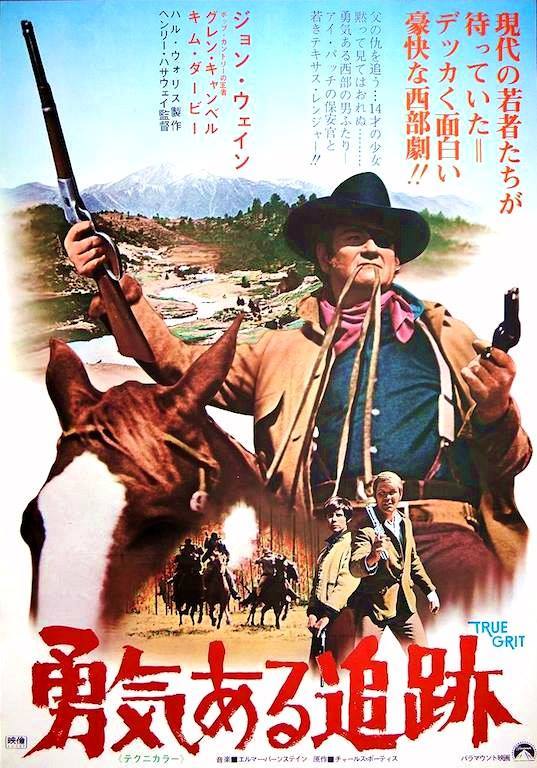
"True Grit" (1969) Japanese Poster

Here's a rare Japanese poster for the 1969 True Grit starring John Wayne:


Thanks to Jeff Bean Green for providing it!

Friday, November 2, 2018

BBC: Why Is "Seven Samurai" So Good?

Above, the Seven Samurai mural at the main entrance to Toho Studios. Photo by Armand Vaquer.

Okay, movie fans! Here's one for you.

Many Japanese kaiju fans have broadened their movie-watching interests into other genres with some focus on prominent Japanese movie directors. Akira Kurosawa is one of them. Many Japanese movie fans have enjoyed a long list of Kurosawa movies, most prominently is Seven Samurai (1954). This includes me. I have a copy of Seven Samurai.

The BBC has an interesting article on Seven Samurai, "Why is Seven Samurai so good?"

It begins with:
Akira Kurosawa's Seven Samurai (1954) is a three-and-a half-hour-long black-and-white epic set in war-torn, 16th-Century Japan. As elevator pitches go, it’s hardly ideal, yet not only did Seven Samurai take first place in BBC Culture’s 100 greatest foreign-language film poll, with 41 critics (20 per cent of the total) voting for it, Kurosawa was one of the most popular directors overall, with three of his other films (Rashomon, Ikiru and Ran) all making the top 100. Tellingly, though, Kurosawa’s global appeal didn’t reach as far as the Japanese critics who took part; not one of them voted for Seven Samurai, or any other Kurosawa film, preferring the subtler homegrown talents of Yasujirô Ozu and Kenji Mizoguchi. But perhaps that’s what we should have expected. Even during his most successful film-making years, Kurosawa was often held in higher esteem abroad than in his own country.
The article is an interesting read. I recommend it!

Interestingly, Seven Samurai and Godzilla were both boxoffice hits in 1954 and both are honored with murals at the main entrance to Toho Studios in the Setagaya ward of Tokyo.

To read the full article, go here

Thursday, January 4, 2018

Japan Air Carriers Ranked Most Punctual

Above, an All Nippon Airways jet at Narita Airport. Photo by Armand Vaquer.

If one wants to go to Japan and feels they need some assurance that they will likely get to their destination on time, flying aboard a Japanese carrier is probably what they should do.

News18.com reported:
When it comes to arriving to your destination on time, Japanese carriers have emerged the most reliable, taking up the top two spots on a ranking of the most punctual airlines in the world.  
With an on-time performance (OTP) of 85 percent, Japan Airlines was the most punctual airline of 2017 in the category of world's mega airlines, followed closely by rival All Nippon Airways, which likewise delivered their passengers to their destinations 84 percent of the time.

In the interest of full disclosure, I have never flown to Japan aboard a Japanese airline. I've flown on United (2), Singapore Air (2) and Korean Airlines (4).

To read more, go here.

Tuesday, December 26, 2017

Ryokan Custom Ignites "Sexism" Debate

Above, a ryokan meal service. Photo by Armand Vaquer.

Things are getting strange in this world.

Some people are complaining about all kinds of customs or practices that have been generational in the U.S. and Europe. Many are charging that many practices and customs reek of sexism.

It appears that Japan is not immune to such charges. Visitors to Japan are complaining that a Japanese custom during meal service in ryokans is "sexist". It seems people have nothing better to do than to complain about something.

Japan Today reported:
TOKYO - In Japan, nothing transports you back in time to a bygone era like a stay at a ryokan, or traditional Japanese inn. Often found in rural areas, this type of accommodation typically features tatami mat rooms, communal baths and dining areas, and yukata outfits, which visitors wear during their stay while being served by owners and staff in traditional clothing. 
During mealtimes, guests are treated to sumptuous meals, which are often laid out on a traditional low table before they arrive, with things like tea, soup and rice served upon arrival. One of the many traditions guests encounter while staying at a Japanese inn is the fact that at mealtimes, they’ll usually be given a large portion of rice in a tub with a lid, called an ohitsu, which is placed beside the table with a shamoji rice paddle for serving, so that the diners can eat as much rice as they like throughout the course of the meal. 
While it might seem like the ohitsu adds a nice touch to the meal, it’s actually become the subject of intense debate online recently, as the ohitsu is usually placed next to the woman at the table when she’s with a male partner, as it’s assumed she’ll be the one serving him rice during the meal. 
While the traditional role of women as housewives still persists throughout a lot of rural areas in Japan, attitudes are changing, and some people are now questioning whether or not the custom of placing the ohitsu beside women dining with husbands or boyfriends should continue.
If someone who comes to Japan and stays at a ryokan to fully experience Japanese culture but complains that a custom is "sexist", they should do everyone a favor and stay home.

To read more, go here.

Search This Blog