"There is no limit to what a man can do or where he can go if he doesn't mind who gets the credit." - President Ronald Reagan.

Buy The Amazon Kindle Store Ebook Edition

Buy The Amazon Kindle Store Ebook Edition
Get the ebook edition here! (Click image.)
Showing posts with label Lake Kawaguchi. Show all posts

Friday, February 28, 2025

Time Out: Guide To Hakone

Above, a boat cruise on Lake Ashi. Photo by Armand Vaquer.

Back in 2004, the first G-TOUR to Japan took place. It was sponsored by G-FAN magazine. 60 Godzilla/Daikaiju Eiga fans went on the tour.

One of the stops (an overnighter) was Hakone. The stop included Mount Fuji, Lake Ashi and a fireworks show at Lake Kawaguchi.

Time Out Tokyo has posted a guide to Hakone, with the best things to see and do.

They begin with:

The mountainous town of Hakone lies about an hour and a half by train from Tokyo, making it a popular day trip or weekend getaway from the capital. It has had a long and illustrious tradition as a hot spring town – its name even appears in Edo-era (1603-1868) rankings of Japan’s best onsen.

But Hakone is about much more than just bathing. It’s got everything from superb art museums to an active volcano, as well as a jaw-dropping view of Mt Fuji on clear days. These are our top picks of things to do and see around the area, from central Hakone-Yumoto and beautiful Lake Ashi to posh but relaxed Gora, which is still one of the most in-demand neighbourhoods for moneyed Tokyo folks looking for a second home.

To see the guide, go here

Thursday, April 28, 2022

Tokyo Cheapo: Tokyo To Mount Fuji Guide

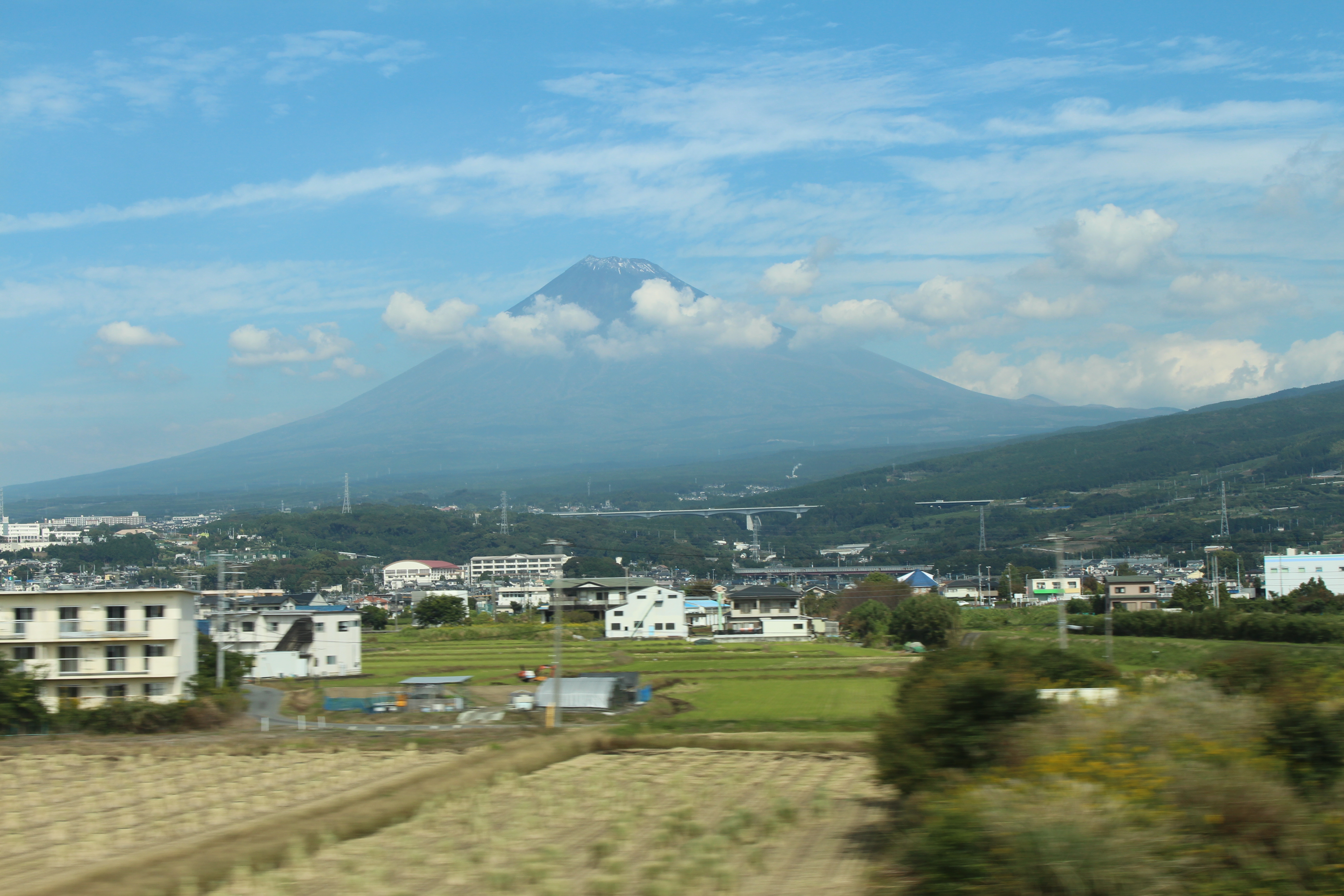
Above, a shinkansen view of Mount Fuji. Photo by Armand Vaquer.

One of these days, the Japanese government will reopen its borders to foreign tourists. But that doesn't seem to be happening anytime soon. (I would be happy to be proven wrong in this instance.)

So, as people are busy twitting their their thumbs waiting for that reopening, they should instead start planning their next (or first) vacation in Japan. If a visit to the symbol of Japan, Mount Fuji is in their plans, Tokyo Cheapo has an article on how to get there from Tokyo.

They begin with:

So you want to see Mt Fuji, that 3,776-meter-high icon of Japan? It’s actually a volcano, but let’s not think too much about that… Whether you plan to climb to the summit or just Fuji-spot around the lakes below, there are a few different transport options. Here’s an overview of how you can get from Tokyo to Mt Fuji, in or out of the climbing season, plus other useful stuff to know.
Above, a nighttime view of Mount Fuji from Lake Kawaguchi. Photo by Armand Vaquer.

To read more, go here

Monday, November 15, 2021

Japan's First "Highest Altitude Fireworks Display" At Mount Fuji

Above, a Shinkansen view of Mount Fuji. Photo by Armand Vaquer.

Plans are underway for Japan's "first highest altitude fireworks display" from the lower slopes of Mount Fuji.

According to Japan Today:

TOKYO - Though fireworks are most commonly associated with summer festivals in Japan, there’s no rule that says you can’t enjoy them year round; and during the colder months when skies are clearer, the colorful displays contrast against the dark of night and appear to shine brighter than ever.

On the 18th of December this year, the lower slopes of Mount Fuji will become the setting for "Japan’s highest altitude fireworks display" when approximately 5,000 fireworks will be launched from the second station of the Fujinomiya trail.

The display will be taking place at Amusement Park Grinpa, which is located at the second station of the Fujinomiya trail (with most hikers starting their Fuji climb from the fifth stations, it’s also a great opportunity to get acquainted with the lesser-visited lower end of the trail).

Seventeen years ago (it hardly seems that long ago), the first G-TOUR had the tour group at Lake Kawaguchi for a fireworks festival. Silhouetted against the night sky was Mount Fuji. It was a display that the tour group never forgot. 

Too bad that tourists won't be able to see this display since the country is closed to foreign visitors. Hopefully, this display will be an annual event after the pandemic ends.

To read more, go here.

Friday, September 17, 2021

Seasons And The Best Time To See Mount Fuji

Above, a view of Mount Fuji from a Shinkansen train to Osaka. Photo by Armand Vaquer.

Prior to my last trip to Japan in October 2015, I had visited Japan seven times and during those trips I had not been able to get a clear daytime view of Mount Fuji (whenever I was in its vicinity).

The first time I was able to see it was at night in 2004 while at Lake Kawaguchi for a fireworks festival.

My only time I was able to view it in daylight was during my 2015 trip while taking a Shinkansen train to Osaka.

For those planning to visit Japan and wish to see Japan's most famous mountain, Live Japan has information on the best viewing months so tourists can plan accordingly (once the pandemic is over).

They begin with:

Mount Fuji isn’t always visible from Tokyo and even if you stay for a week, weather and season might have it hide behind clouds the entire time. But for most people, seeing Japan's most famous mountain is at the top of the bucket list. So, to help you plan: when are the best chances of seeing Mount Fuji?

Which season is the best, when is the best time of the day? And how is the weather at Mt. Fuji connected to how it looks? We’ll tell you when to best see Mount Fuji in all its glory from various angles!

To read more, go here

Sunday, January 26, 2020

Where To Get The Best View of Mount Fuji

Above, a view of Mount Fuji from a bullet train. Photo by Armand Vaquer.

Of all of the eight times I've been to Japan, the only times I've been able to get decent enough views of Mount Fuji were during G-TOUR in 2004 when we were actually on the side of the mountain (at the timberline) and during the fireworks festival at Lake Kawaguchi and during a 2015 shinkansen trip to Kyoto and Osaka.

Above, the top of Mount Fuji from the timberline. Photo by Armand Vaquer.

The mountain, during other times, was obscured by cloud cover.

However, Time Out Tokyo has an article on five of the best places to view Mount Fuji.

They begin with:
The highest peak in Japan at 3,776m, Mt Fuji is stunning for its elegant, perfectly symmetrical shape. It is the icon of Japan, one that many tourists want to see on their trip to Tokyo. While it’s possible to get a glimpse of the mountain in the capital – when the weather is super clear – you should travel slightly out of the city to the areas surrounding the mountain for the perfect view. 
Of course, the best is still to go hiking up the mountain in summer from July to September. But if you’re not keen on the physical workout, these five scenic spots in Yamanashi and Kanagawa – easily reachable from Tokyo as a day trip – are your next best bet for a spectacular view of Mt Fuji. Just try to get there early in the morning or late afternoon as the mid-day clouds tend to block the view (especially in the summer).
To read more, go here

Tuesday, March 26, 2019

Getting To Mount Fuji and Back From Tokyo

Above, a bullet train view of Mount Fuji. Photo by Armand Vaquer.

Back in 2004, G-TOUR (of which I was part of) made a trip to Mount Fuji. While in the area, we were bused to one of the Fifth Stations and, later, enjoyed a fireworks festival at Lake Kawaguchi, one of the surrounding lakes.

On the way to the Fifth Station, we made a stop at the mountain's timberline to view the summit.

Above, a view of Mount Fuji's summit from the timberline. Photo by Armand Vaquer.

For those who are planning a trip to Japan and would like to take a day trip or an overnighter visit to Japan's symbol, Tokyo Cheapo has posted an article on how to get to Mount Fuji and back.

They begin it with:
So you want to see Mount Fuji, that 3,776-meter-high icon of Japan? It’s a volcano, but let’s not think too much about that. Depending on what it is you plan to do there (climbing to the summit or exploring the surrounding lakes, soaking in a hot spring or shopping), your choice of transport is going to differ. Here’s an overview of how you can get from Tokyo to Mount Fuji, in or out of season, looking at the various train and bus options.

To read more, go here

Saturday, January 12, 2019

Time Out Tokyo Guide To Hakone

Above, boating on Lake Ashi in Hakone. Photo by Armand Vaquer.

Following a summer's night of fireworks at Lake Kawaguchi, the 2004 G-TOUR spent the night at a hotel in Hakone and did a little touring of the area.

Part of our route out of the Hakone area included a boat ride on Lake Ashi. Lake Ashi was featured in the 1967 movie, Gappa: The Triphibian Monster.

Time Out Tokyo has posed a guide to Hakone for things to see and do while there.

They begin with:
The mountain of Hakone lies about an hour and a half by train from Tokyo, which makes it a popular day-trip or weekend getaway from the capital. It has had a long and illustrious tradition as a hot spring town – its name even appears in Edo-era (1603-1868) rankings of Japan’s best onsen. But Hakone is about much more than just bathing. It’s got everything from superb art museums to an active volcano – as well as a jaw-dropping view of Mt Fuji on clear days. These are our top picks of things to do and see around the area, from central Hakone-Yumoto and beautiful Lake Ashi to posh but relaxed Gora, which is still one of the most in-demand neighbourhoods for moneyed Tokyo folks looking for a second home.

To read more, go here

Tuesday, January 2, 2018

Mount Fuji Hotel Deal

Above, a shinkansen view of Mount Fuji in 2015. Photo by Armand Vaquer.

During my eight trips to Japan over the years, one of the rarest things for me was to get a clear daytime view of Mount Fuji.

During G-TOUR in 2004, we drove up the mountain to one of the Fifth Stations. Although we had clear views, we were too up close (well, we were on the mountainside) to really savor the majestic shape of the mountain. We were able to see the full shape one night during the trip. It was during a fireworks festival at Lake Kawaguchi were we were able to see all of Mount Fuji, but in silhouette.

In was only during my 2015 trip to Japan that I caught clear views of it aboard the shinkansen.

Since such clear views of Mount Fuji are so infrequent, and even rarer for travelers, a hotel in Yamanashi Prefecture has a special deal for tourists.

Japan Today reported:
TOKYO - It’s kind of ironic that while Mt Fuji is one of, if not the absolute, most iconic views of Japan, it’s also one of the least reliable. Due to the surrounding weather patterns and topography, Mt Fuji is often covered in clouds and mists, much to the disappointment of travelers with their cameras out and ready as they speed past it on the Shinkansen, or, even more heartbreakingly, who make reservations at local hotels specifically for the purpose of gazing upon the mountain’s majesty. 
Visibility is an especially big concern for the guests of Yamanashi Prefecture’s Hotel Mt Fuji. As you can guess from its name, the hotel’s main draw is its Fuji views, not only from its guestrooms but also from its rooftop open-air baths, which were newly renovated this past August. 
The management knows that guests who happen to stay at the hotel on a cloudy day are probably going to go home disappointed, and so it has a plan to help ease the pain. Between Jan 9 and 19, if you’re unable to see the peak of Mt. Fuji for at least a minute due to cloudy or snowy weather between when you check in and check out, you can come back and stay at the hotel for another night free of charge on a later date.

To read more, go here.

Friday, December 9, 2016

Hakone "One Day Tour"

Above, Lake Ashi. Photo by Armand Vaquer.

Following a viewing of a fireworks festival at Lake Kawaguchi with the silhouette of Mount Fuji in the background, G-TOUR in 2004 spent the night at a Hakone hotel and, on the following day, sailed on Lake Ashi, rode cable cars and tasted eggs cooked in volcanic waters.

One day in Hakone is really not enough, but there is a self-guided "One Day Tour" to get a good taste of Hakone if one day is all you have.

According to Japan Today:
HAKONE —A fierce contender for the most picture-perfect area in Japan, it’s not hard to see why Hakone consistently ranks high on “Best of Japan” destination lists. 
Glory-hallelujah mountain scenery, hot springs in every forested nook and cranny, an extraordinarily efficient transport network (featuring a ropeway, cable car, buses and a scenic railway) as well as a wide range of outdoor activities make Hakone a destination that can pretty much market itself. Tourists usually stop by on a tour of the Kanto region, for which the town is the ancient entry point, soaking away several nights in a traditional onsen ryokan for a classic Japan experience. 
Now, though, Hakone is hoping to attract those travelers who might not have as much time to spend in the region with an inspired travel package called the “One Day Tour.” It’s a sort of tourists’ toolkit that presents three model travel itineraries to follow (self-guided) and includes round-trip tickets to and from Tokyo, plus free use of all Odakyu transport while you’re there; discounts on entrance tickets to various attractions, and coupons for food and shopping in both Tokyo, at the Odakyu Department Store, and various shops in and around Hakone.
For more details, go here

Thursday, September 29, 2016

Visit Hakone

Above, a torii gate on the shore of Lake Ashi. Photo by Armand Vaquer.

12 years ago, the first G-TOUR spent the night in Hakone after the tour group enjoyed an evening of fireworks at Lake Kawaguchi near Mount Fuji.

The tour group enjoyed the Hakone area, including a cruise on Lake Ashi and riding the aerial tramway over the volcanic areas of Owakudani Valley.

City-Cost has an article on things to see and do in Hakone and how to get there from Tokyo.

They begin it with:
Hakone (箱根) must be one of the premier getaways for residents of Tokyo, as well as a Japan bucket list mainstay for travellers to this part of the world. Rightly so. Hakone has much to offer. Too much maybe. The visitor here is spoilt for choice; onsen, lake-based activities, bonkers outdoor art installations, Mt. Fuji views, history, Spartan marathon races, storied hotels, and hard-boiled eggs that come out black (the shells of eggs sold at Owakudani). This and plenty more.  
Visitors to Japan will find Hakone an interesting and enjoyable area to experience.

Godzilla fans are familiar with Hakone as the battleground between Godzilla and Baragon in Godzilla, Mothra and King Ghidorah: Giant Monsters All-Out Attack (2001). Hakone is spotlighted on page 36 of The Monster Movie Fan's Guide To Japan.

To read more, go here

Thursday, September 8, 2016

3 Things To Do In The Lake Kawaguchi and Mount Fuji Area

Above, the Lake Kawaguchi fireworks festival in 2004. Video and video shapshot by Armand Vaquer.

Back in 2004, the first G-TOUR had the tour group at Lake Kawaguchi near Mount Fuji for an evening of fireworks.

It was the annual fireworks festival held in August of several fireworks companies in competition. The beneficiaries of the competition were the observers gathered along the shoreline.

The fireworks were detonated across the lake from us and they were a beautiful sight to behold, with the fireworks reflecting on the lake.

There are other things to see and do in the area of Lake Kawaguchi and Mount Fuji. Japan Info has three of them for your consideration.

They begin with:
Lake Kawaguchi is the most accessible of the Fuji Five Lakes with direct trains and bus routes from Tokyo. The lake not only boasts some great tourist attractions but also has some excellent views of Mount Fuji, especially when framed by delicate sakura blossoms or vibrant autumn foliage. Lake Kawaguchi is my favorite place to stay when visiting this area as it has a number of hotels, hostels, and ryokans to stay in and a lot of shops and restaurants, too. Around Lake Kawaguchi is many beautiful views – Sakura trees and Momiji trees were strategically planted to give brilliant vistas across the lake with Mount Fuji in the backdrop. If you want more of a bird’s-eye view, you can travel up the Kachi Kachi Ropeway. Traveling up by cable car (or ropeway in Japan), you will get a stunning view of the lake. You may notice many plastic animals lining the way playing out a story. These are the rabbits and Japanese raccoon dogs (tanuki) in a vengeful battle, but you’ll have to visit yourself to see how it turns out. Lake Kawaguchi also serves as a hub for accessing other local areas, such as the Fuji-Q Highland and Oshino Hakkai. Here are my 3 top recommendations for things to do and see around Lake Kawaguchi and Mount Fuji.
To read more, go here

Saturday, June 18, 2016

Mt. Fuji-Shizuoka Area Tourist Pass Mini

Above, a ferry on Lake Ashii. Photo by Armand Vaquer.

Some of the most scenic areas of Japan is the Mount Fuji-Shizuoka area of Japan.

G-TOUR 2004 paid a visit there, which included going to one of the Fifth Stations on Mount Fuji, a fireworks festival at Lake Kawaguchi, an overnight stay in Hakone and a boat ride on Lake Ashii.

Above, the fireworks festival at Lake Kawaguchi in 2004. Photo from video by Armand Vaquer.

The Japan National Tourism Organization (JNTO) as a new tourist pass for the Mount Fuji-Shizuoka area.

They announced:
Central Japan Railway Company successfully launched the Takayama-Hokuriku Area Tourist Pass and Alpine-Takayama-Matsumoto Area Tourist Pass in efforts to attract more overseas tourists to the Shoryudo region of Japan. 
The newly-launched Mt-Fuji-Shizuoka Area Tourist Pass Mini allows overseas visitors to tour the Shizuoka area focusing on Mt Fuji. 
Enjoy a trip to Shizuoka, full of great tourist attractions and feast your eyes on the magnificent Mt Fuji while taking rail, bus and ferry.

Above, a view of Mount Fuji from the shinkansen. Photo by Armand Vaquer.

I am planning a return visit to the Mount Fuji-Hakone area during my next Japan trip, so this will come in quite handy!

For more information on the tourist pass, go here.

Thursday, June 12, 2014

Hakone

Above, Lake Ashi and torii gate. Photo by Armand Vaquer.

One of the most scenic areas of Japan has to be the Hakone area.

Here, you have five lakes, mountains (dominated by Mount Fuji), skyways/ropeways, steaming volcanic lands, shrines, onsens and many other things to enjoy.

I visited Hakone with the 2004 G-TOUR. During the visit, we enjoyed a fireworks festival at Lake Kawaguchi, rode the aerial ropeway in Owakudani Valley, took a boat ride on Lake Ashi and paid a visit to the Fifth Station at Mount Fuji.

Above, the aerial skyway over the Owakudani Valley. Photo by Armand Vaquer.

Modern Tokyo Times has an article on Hakone and the many museums that can be visited there.

They begin with:
Hakone is a very popular tourist destination because you have so many places to visit and the views of Mount Fuji in certain locations are extremely stunning. Throughout Hakone you have many museums and cultural wise the area is very rich in history. This certainly applies to Hakone Jinja (Hakone Shrine) whereby the Shinto faith blends naturally with nature. Also, the historical treasure museum based on the rich history of Hakone Jinja is certainly worth visiting because you have several amazing gems to view.
One nice thing about visiting Hakone during the hot summer months, it was pleasantly cool during our visit, which gave us a break from the heat and humidity we experienced in Tokyo.

To read more on Hakone, go here.

Saturday, November 9, 2013

Mt. Fuji Climbers Face Entrance Fees Around-The-Clock In 2014

Above, climbers's lights on the slopes of Mount Fuji seen from Lake Kawaguchi.  Photo by Armand Vaquer.

Climbers of Japan's Mount Fuji face paying entrance fees around-the-clock next year, according to the Mainichi Shimbun.

They wrote:
Climbers of Mount Fuji face having to pay round-the-clock entrance fees starting next year, a move partly aimed at curving overnight hikers attempting to dodge the financial burden, it has been learned. 
Admission to the country's highest peak currently costs 1,000 yen per daytime climber between July and August. However, a joint expert panel of Shizuoka and Yamanashi prefectures proposed in Tokyo on Nov. 7 that the fee should be collected 24 hours a day, calling for fair sharing of burdens among climbers including so-called "bullet climbers" -- those who hastily ascend the peak overnight without resting at mountain lodges.
¥1,000 is roughly $10.00.

To read the full story, go here

Wednesday, October 23, 2013

Thank-You To 800,000 Viewers!

Above, fireworks over Lake Kawaguchi in Japan.  Screen shot from video by Armand Vaquer.

Armand's Rancho Del Cielo (named for President Ronald Reagan's beloved ranch near Santa Barbara, California) has reached another milestone today.

We've reached over 800,000 page views since the blog's inception in 2008! A big thank-you to those of you who've stopped by! The blog will top one million page views within the next few months.

Apparently, we're doing something right to be generating such interest. It must be because this is not a "one-trick pony" blog as some of them are. Many I've seen are self-aggrandizing and just plain too dull to even bother looking at. Viewers from all around the globe have visited here.

This blog covers a larger gamut of topics, including travel, history, current events, politics and entertainment. It helps to inject a little humor into blog posts to keep things interesting.

Next stop, one million!


Wednesday, July 3, 2013

Lake Kawaguchiko's "Kojōsai" Festival

Above, Lake Kawaguchi's fireworks are reflected
upon the lake's waters. Photo by Armand Vaquer.

Tomorrow is Independence Day, which conjures up thoughts of bar-b-ques and fireworks.

The most memorable fireworks display in recent years for me actually didn't take place on Independence Day, nor did it even take place in the United States.

I would have to say that the most memorable fireworks display had to be during G-Tour in 2004 when we attended the Lake Kawakuchi fireworks festival (Lake Kawaguchiko's "Kojōsai" Festival).

Above, climbers' lights can be seen on the slopes of the
silhouetted Mt. Fuji from Lake Kawaguchi.  Photo by Armand Vaquer.

Lake Kawaguchi is one of the five lakes near Mount Fuji (now a World Heritage site). On clear days, Mount Fuji can be seen from Lake Kawaguchi.  When we arrived at the lake, Fuji was obscured by cloud cover.  But just before the fireworks show began, the sky cleared and we were able to see the silhouette of Mount Fuji against the night sky.

After a full day of touring, this was a relaxing respite for the group. Luckily, there were food vendors (photo below) at the viewing area and most everyone were famished and gave the vendors a lot of business.


On the slopes of Mount Fuji, tiny lights can be seen making their way to the summit. These are climbers who climb Fuji to view the morning sunrise. Since Mount Fuji has been designated a World Heritage site, it is speculated that this will cause an increase in the numbers of climbers. As a test,  a ¥1,000 admission fee will be charged on a trial basis for about 10 days from July 25. [See this article from The Japan Times.]

Above, the festival is comprised of competing
fireworks companies.  Photo by Armand Vaquer.

The fireworks display lasted about an hour or so. The fireworks festival is held annually for competing fireworks companies to display their goods. It was a smart move to make Lake Kawaguchiko's "Kojōsai" Festival as an "anchor" when planning the tour.  For information, go here.

The accompanying photographs are screen captures of a video I shot with a Hi8 camcorder.

Search This Blog