"There is no limit to what a man can do or where he can go if he doesn't mind who gets the credit." - President Ronald Reagan.

Buy The Amazon Kindle Store Ebook Edition

Buy The Amazon Kindle Store Ebook Edition
Get the ebook edition here! (Click image.)
Showing posts with label Anti-Counterfeiting Educational Foundation. Show all posts

Tuesday, November 4, 2025

7 Ways To Test If A Silver Coin Is Real

Above, an ad advertising Canadian Maple Leaf coins that turned out to be fake.

A few years ago, two friends and I bought some purported silver coins through an ad in Facebook. The price of each coin was hard to believe. The old saying, "if it sounds too good to be true, it probably is" rang true.

When I received the coins, I noticed that they looked different from the silver coins I already had. Then, I tried the "magnet test" on them. Silver does not react to magnets, but the coins I bought did. That's how I knew that they were counterfeit. These originated from China.

Above, my magnet test of a fake Morgan dollar. Photo by Armand Vaquer.

MSN has posted an article on how to test if a silver coin is real.

It begins with:

Whether you’ve inherited an old collection, found coins at a flea market, or are starting to invest in precious metals, knowing how to identify genuine silver is essential. Counterfeit silver coins are increasingly sophisticated, but there are reliable ways to spot fakes without damaging your coins. Here’s a detailed guide on how to tell if your silver coin is real.

To read more, go here

Friday, March 7, 2025

Make Your Counterfeit Coins Legal To Own

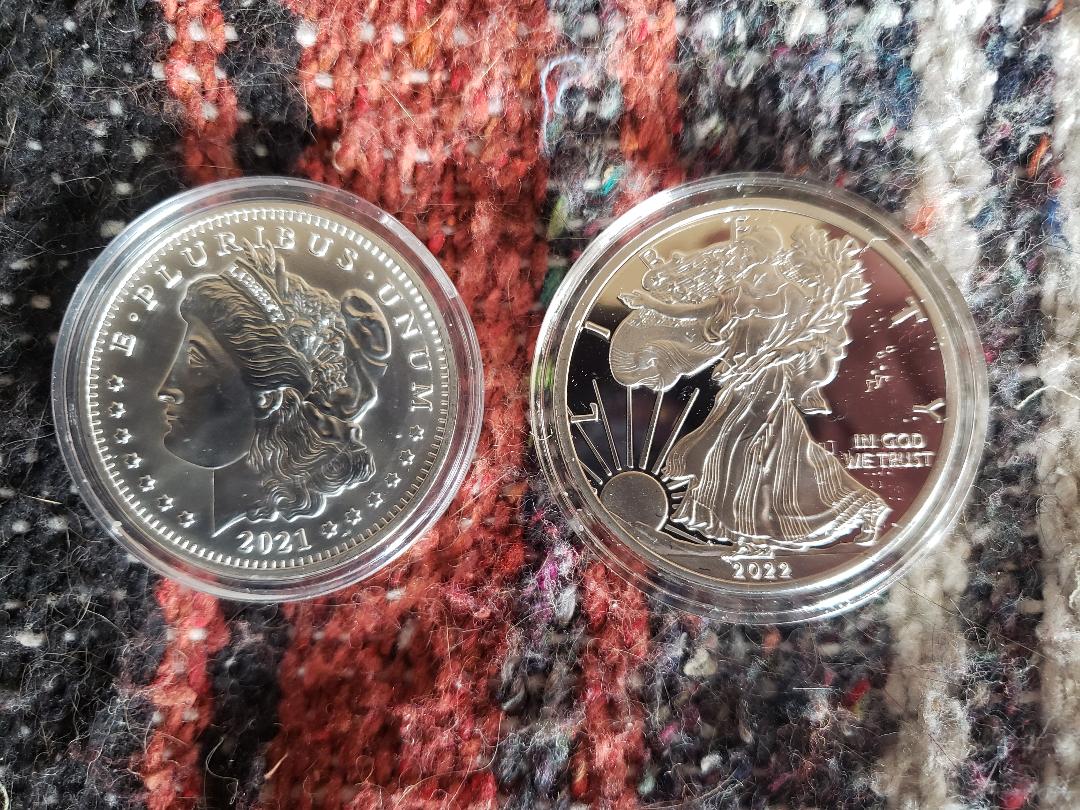
Above, counterfeit Morgan and Silver Eagle. Photo by Armand Vaquer.

Did you know that counterfeit coins are illegal to possess, buy or sell?

According to ACEF, they are:

According to federal law, counterfeit coins are illegal to possess, buy or sell. Hence, once a victim becomes aware that a coin is counterfeit, he/she should turn it over to the nearest Secret Service agent or local law-enforcement official. Often that is impractical because of distance or law enforcement being reluctant to spend time to recover one or two counterfeit items, especially fake coins.

When I bought some counterfeit silver coins a few years ago through an ad in Facebook, I thought they looked wrong and tested them with a magnet. They stuck to the magnet. Silver is not magnetic. It turned out that they originated from China.

I notified the local sheriff and gave the coins to them as I was aware that they are illegal to possess. Thankfully, I got my money back when I notified my bank of the fraud.

However, one can possess counterfeit coins and ACEF tells you how to do so.

By the way, according to ACEF, the Morgan Dollar is the most counterfeited coin:

The Morgan silver dollar is the most frequently counterfeited U.S. coin, according to coin dealers responding to a survey conducted by the Anti-Counterfeiting Task Force in June 2018.

To find out how you can legally own counterfeit coins, go here.

Monday, November 4, 2024

Increase In Fake Numismatic Coins

Above, the two fake coins I bought two years ago. Photo by Armand Vaquer.

Fake coins are still being foisted upon the unwary public. Many of them originate from China. The old tried and true magnet test isn't as reliable as it once was. That was how I found that coins I bought through an ad in Facebook two years ago were fakes. Counterfeiters are starting to use non-magnetic metals for their fakes.

Since then, I now only buy from reputable coin dealers.

Greenfield Recorder posted an article on how to get your money's worth when buying coins.

It begins with:

GREENFIELD — Coin experts across the region are sounding the alarm about an influx of fakes manufactured in China and infiltrating the U.S. market.

Chinese-made counterfeits of collector and circulating coins are more rampant than ever, according to the American Numismatic Association, having greatly improved in their deceptive quality since the 1970s. Still, many are relatively easy for a trained eye to detect and having a piece evaluated by an knowledgeable businessperson or graded by a professional company is the best way to avoid getting shortchanged.

To read more, go here

Friday, October 4, 2024

Magnets Now Unreliable To ID Counterfeit Coins!

Above, fake Morgan dollar and American Eagle coins. Photo by Armand Vaquer.

Two years ago, two friends and I were scammed with counterfeit coins from ads placed on Facebook.

We were able to find out that they were fakes by using the magnet test. Each coin was attracted to the magnets we used. We were able to get our money (or credit card charges) reversed.

Well, that method is no longer reliable.

According to the Anti-Counterfeiting Educational Foundation:

If you’re using a magnet and/or an acid test to identify counterfeit U.S. silver coins, your “technology” is unreliable.

In other words, the counterfeiters are way ahead of you!

There was a time when a small magnet that you could hold in your hand was all you needed. That’s because most of the core metals used make to make counterfeits earlier were “ferromagnetic” – meaning they would be attracted to a magnet. Such metals include iron, steel, nickel or manganese. Even with a thin silver plating covering the outside, the core metal’s properties were strong enough to attract the magnet.

Today’s generation of counterfeits contain metals in the core that are not attracted to a magnet such as lead, titanium, copper, or brass. The outside of the coin is thinly plated with silver to deceive you into believing the coin is real and made of 90 percent or .999 fine silver. Counterfeiters of gold coins prefer to use tungsten for the core because its weight is close to gold. Whereas, most fake silver coins ACEF has cut for testing purposes have centers of lead or copper or layers of both.

Acid has always been the least desired way of testing silver and gold coins. That’s because if you’re wrong and the coin is genuine, you are apt to destroy the coin’s surface and render it undesirable – especially in the collector market. 

We now only buy coins through reputable dealers.

To read more and find out what method is still reliable, go here

Monday, November 20, 2023

Where To Buy Gold and Silver Coins or Bars and Red Flags

Above, coin scam ad from Facebook.

These days, just about every line of business and merchandising has their share of scammers.

A year ago, a couple of friends and I purchased some supposedly silver coins from an ad on Facebook. I thought that the prices of the coins were "too good to be true," but I took a chance and bought a couple.

Sure enough, they were counterfeit. They were not silver as they were magnetic. Silver is not a magnetic metal. I notified Facebook, the police and the Anti-Counterfeiting Educational Foundation (ACEF) along with my credit card company. The credit card company reversed the charge and the police now possess the coins. The scam originated from China.

I now only buy coins and bullion from dealers I trust.

GOBankingRates has an article on "red flags" to look out for when buying gold and silver coins or bars.

They begin it with:

Although coin collecting is intended to be a fun, interesting and potentially lucrative hobby, it’s also a big business — and like any form of trade, there’s always someone out there who’ll try to scam you. A recent report from Transparency Market Research estimated the value of the global coin collection market at $8.7 billion in 2022 and projected that it could surpass $20 billion by 2031.

With all that money at stake, you can be sure that scammers and shady dealers are already figuring out new ways to bilk you out of your money. Thousands of consumers fall victim to rare coin investment schemes every year, according to the Florida Attorney General’s office, and it’s “not uncommon” for individual victims of coin scams to lose more than $100,000 in a single transaction.

Amateur coin collectors are especially vulnerable to scams because they lack the expertise to determine whether the coin being sold or promoted is legitimate. In fact, as the Florida Attorney General’s office noted, few consumers ever profit from investing in rare coins because they “do not know enough information” to make smart investment decisions.

Your chances of being scammed increase when you are dealing in gold and silver coins or bars because those precious metals hold so much potential value — and scam artists know it.

To read more, go here.

Thursday, November 9, 2023

7 First-Time Coin Collector Mistakes

Above, the two counterfeit coins I bought last year. Photo by Armand Vaquer.

My rule of thumb in coin collecting is that I buy what I like. There are those who are new to coin collecting who may be prone to making mistakes.

The only mistake I made was buying two counterfeit coins last year from an ad in Facebook. But my credit card company reversed the charge and I reported the matter to the authorities. I haven't seen the particular counterfeiters advertise in Facebook for months. Hopefully, they got the message and banned their ads.

Yahoo! Finance has posted an article on the seven worse mistakes first-time coin collectors make.

They begin it with:

Collecting coins can be fun and even lucrative. But there are seven mistakes you’ll want to avoid as a first-time coin collector.

Coin Collecting Mistakes To Avoid

Here are the seven most common mistakes you’ll always want to avoid as a first-time coin collector, according to Biltmore Loan and Jewelry:

To see what they are, go here

Monday, October 9, 2023

Storage Tips From The Professional Numismatists Guild

Above, safe deposit boxes in a Swiss bank. Wikipedia public domain photo.

So you bought some gold (or silver) as an investment, now where are you going to store it?

There are three options: home safe, bank safe deposit box and bullion depository.

According to an article at the Anti-Counterfeiting Educational Foundation (ACEF), there are pros and cons to each of these. They have posted an article discussing each. While it mainly pertains to gold, it also applies to silver as well.

They begin with:

(Temecula, California) July 5, 2023 – During the “Gold Rush of 2023,” dealers report that demand for gold bullion coins has soared from both previous investors and many new buyers. Now the important question is: how should you safely protect and store your precious metal purchases?

The Professional Numismatists Guild (www.PNGdealers.org), a nonprofit organization composed of many of the country’s top rare coin and precious metals dealers, advises that the three most popular methods of storage each have advantages and disadvantages.

“The secure storage methods usually considered by investors are a home safe, a safe deposit box at a bank or other financial institution, and/or a third-party bullion depository. Buyers of rare coins or gold, silver or platinum bullion coins or ingots should carefully consider which approach is best for them,” said PNG President Wayde Milas.

Here are comments from some PNG member-dealers about the pros and cons of different types of secure storage.

To read more, go here

Wednesday, July 5, 2023

Another Counterfeit Coin Facebook Ad

Above, a screen capture of the ad.

Facebook has been very lax in vetting advertising from so-called silver coin dealers and allowing obvious fraudulent ads appear on the social media platform.

The latest is a scheme to sell alleged proof American Silver Eagle coins with presentation boxes for $9.98 each by a company called Avaliry. This price is way below the current silver spot price of a little over $23.00/toz. 

I bought an American Silver Eagle Proof coin directly from the U.S. Mint at the National Money Show for $80.00. While doing so, the director of the U.S. Mint, Ventris C. Gibson, autographed my purchase.

Above, a real American Silver Eagle proof set signed
by the direct of the U.S. Mint. Photo by Armand Vaquer.

Other similar ads have been popping up on Facebook with the same format (under different names) using a video. Some were even offering the "proof" coins for $7.98 each. No doubt these are Chinese counterfeits. 

I have notified Facebook. I am sending this blog post to Doug Davis at the Anti-Counterfeiting Educational Foundation (ACEF).

Tuesday, July 4, 2023

Counterfeit Coin Training For Law Enforcement

Above, counterfeit coins I bought last year. Photo by Armand Vaquer.

Since I and a couple of friends managed to buy counterfeit "silver" coins last year, this is a topic of interest to me.

A seminar for law enforcement on counterfeit coins will be held at the American Numismatic Association's World's Fair of Money in Pittsburgh next month.

Greysheet reported:

(Pittsburgh, Pennsylvania) -- To address the mass proliferation of counterfeits plaguing the U.S. marketplace, the Anti-Counterfeiting Educational Foundation (www.ACEFonline.org) in partnership with the U.S. Treasury Department and in cooperation with the American Numismatic Association will sponsor an accredited seminar for local, county, state, and federal law enforcement agencies.

Entitled, “Counterfeit Coins, Precious Metals, Numismatic and Financial Crime Investigations,” the eight-hour seminar will be conducted on Thursday, August 10, during the ANA 2023 Pittsburgh World’s Fair of Money® in the David L. Lawrence Convention Center. Instructors for the seminar will be former Texas Police Chief Doug Davis, Director of the ACEF Anti-Counterfeiting Task Force, and Chris Hersey, Senior Special Agent in the Treasury Department’s Office of the Inspector General.

“The curriculum during the 8:30 am to 4:30 pm seminar will provide law enforcement attendees from across the country with the fundamental investigative techniques, resources, knowledge and understanding to respond effectively to the complex challenges encountered during the investigation of crimes related to counterfeit coinage and precious metals as well as other numismatic and related financial crimes,” explained Davis. 

Based on our dealings with law enforcement over the counterfeit coins my friends and I bought last year, this seminar is needed as the police we dealt with really didn't know what to do when we reported the crime. I urge police agencies around the country to attend this seminar.

I reported the matter to ACEF and dealt with Doug Davis on it. The coins originated from China.

To read more, go here.

Thursday, June 1, 2023

Replies To Numismatic News On Counterfeit Coins

Above, the counterfeit coins I bought last year. Photo  by Armand Vaquer.

Recently, Numismatic News asked this question:

Have you encountered or unknowingly acquired ma counterfeit coin? If so, what did you do?

They received a number of responses and all are interesting.

As readers of this blog know, last year I bought two counterfeit coins. It turned out that they originated from China and were sold through an ad on Facebook. I had my suspicions, but I took a chance anyway.

When they arrived, I gave them the magnet test. Sure enough, both coins stuck to the magnet. Silver is not magnetic, by the way.

My bank reversed the charges, so I didn't lose anything. I turned the coins over to the New Mexico McKinley County Sheriff.

To read the responses to Numismatic News's question, go here.

Wednesday, May 24, 2023

Counterfeit 1903 Barber Dime Detection

Above, a Barber dime. JM Bullion photo.


After having been taken in by Chinese coin counterfeiters last year, the topic of counterfeit coins naturally will catch my attention when they are posted.

Such is the case of counterfeit Barber dimes. I have four Barber quarters in my collection, three are culls (what aren't worth all that much even through they are silver) and one that I found on a sidewalk, but no Barber dimes. They ae named for United States Mint chief engraver Charles Barber.

CoinWeek posted an article on detecting counterfeit Barber dimes, particularly the 1903 Barber dime. By the way, Barber dimes are composed of 90% silver and 10% copper.

They start it with:

The Barber Dime series (1892-1916) holds one of the greatest rarities in United States numismatics: the 1894-S. Fewer than a dozen of these Proof coins are currently known to the collecting world, and on the rare occasion that they are offered at auction, they command prices over $1 million (USD). Their value has attracted the attention of counterfeiters, who have created outright fakes or added an ‘S’ mintmark to an 1894-dated dime from Philadelphia. Third-party authentication is essential for any coin purporting to be an 1894-S dime.  
In contrast, such scrutiny is often absent for the business strike 1903 Barber dime. It’s not a key date, and generally isn’t worth over $100 except in Mint State condition, according to price guides. In fact, the 1903-O and 1903-S business strikes are each more valuable. Because this is a coin for which some collectors might skip certification it creates a different kind of opportunity for counterfeiters.

 To read the full article, go here.

Monday, March 6, 2023

Review of the National Money Show

Above, the National Money Show in Phoenix. Photo by Armand Vaquer.

The National Money Show in Phoenix this past week at the Phoenix Convention Center was an enjoyable event. It seemed to be well-organized with a huge room of dealers from around the country.

There were all kinds of coins, bullion, rounds and ingots to be had. There were special presentations and seminars during the show, there were none that I was interested in on Saturday. People of all ages were in attendance, which is a good sign. I spent a few hundred dollars there.

There were some things I noticed. One, I saw no dealers with coin collecting supplies such as capsules, cases (there was one lady selling used cases), boxes and other items for collection organizing. I thought this was odd. 

Above, the show's main entrance. Photo by Armand Vaquer.

Another thing I noticed was that on Saturday (the free admission day), about half of the dealers began packing up to leave about three hours after the show started (10:00). Other dealers who stayed open remarked that they, too, thought it was odd since there were plenty of people wandering the aisles. 

There were new coins along with old ones. It seemed that the older coins were dominated by Morgan silver dollars, which was fine with me (my favorite coin). Just about every dealer had them. I should have made a list of the ones I have and so that I could reference it and just look for the ones I don't have. My mistake. I was hoping to meet Doug Davis of the Anti-Counterfeit Educational Foundation. I didn't see him. He was on the schedule earlier in the week. Each dealer I spoke with were friendly and willing to answer whatever questions I had.

Above, Mitch Geriminsky and I with U.S. Mint Director Ventris C. Gibson.

The National Money Show is sponsored by the American Numismatic Association (ANA), based in Colorado Springs, Colorado. They put on two shows per year: The World's Fair of Money in the summer, and the National Money Show in the spring. The cities for each show change each year.

Looking at this year's schedule, the World's Fair of Money this summer will be held in Pittsburgh on August 8-12, 2023. 

Vendors included private and public coin businesses, coin clubs and the U.S. Mint. Memberships in the ANA were also available. I got myself a senior Platinum ANA membership at the show. 

If either of the shows are scheduled in a nearby city in the future, I will attend. I had a great time. The three and a half hours we were there went by quickly.

For more information on the American Numismatic Association, go here.

Friday, February 17, 2023

ACEF Director At The National Money Show


When I found that I had bought two Chinese counterfeit coins a few months ago, besides notifying the local sheriff, Facebook (where the ad for them appeared) and the Anti-Counterfeiting Educational Foundation, I worked with Doug Davis, director of the ACEF in providing documentation on the counterfeits and the people behind them

As things should turn out, Mr. Davis will be attending the National Money Show March 2-4 in Phoenix. I am also attending this show and am looking forward to meeting him in person.

From the ACEF website:

March 2-4, 2023 Doug Davis, Director of Anti-Counterfeiting Task Force will be attend the ANA 2023 National Money Show in Phoenix AZ. View $MILLIONS$ in rare coins and numismatic treasures. Buy, sell and trade with hundreds of coin dealers, attend lectures and presentations from noted numismatists, and find out what your old coins may be worth! Learn more!

 For more information, go here.

Monday, January 30, 2023

Beware of Scams in 2023 “Gold Rush”

Above, the fake coins I purchased. Photo by Armand Vaquer.

As one who got lured into a "too good to be true" counterfeit silver coin purchase from scammers, it cannot be overstated to warn people to be careful when buying bullion and coins.

Luckily, I got the money I paid returned.

From EIN News:

TEMECULA, CALIFORNIA, UNITED STATES, January 30, 2023 /EINPresswire.com/ -- With gold prices now holding above $1,900 an ounce and silver at about $23, investors in the market to buy physical gold or silver should prudently take the time to shop around to avoid overpaying for purchases. They should also be wary of potential counterfeits in the marketplace and mistaking plated “gold coins” for actual bullion products, cautions leaders of the nonprofit Professional Numismatists Guild (PNG www.PNGdealers.org) and their Accredited Precious Metals Dealers (APMD www.APMDdealers.org) division.

“Adding gold, silver, or platinum bullion coins or ingots to an investment portfolio can be a smart choice, but knowing your seller can be a crucial choice,” advised PNG-APMD President Wayde Milas.

“To avoid potential scams, such as counterfeits, and to avoid paying too much when you buy or receiving too little when you sell, investors absolutely must know the credentials of the bullion dealer. If you don’t know gold, you’d better know your gold dealer,” stated Milas.

Buyers should be cautious of an increase in counterfeit coins offered in the marketplace by unscrupulous sellers and beware of scam artists trying to lure investors with urgent claims of too-good-to-be-true low prices and quick, guaranteed profits.

To read more, go here.

Saturday, January 21, 2023

Chinese Counterfeit Coin Charges Credited

Above, the two counterfeit coins involved. Photo by Armand Vaquer.

Good news arrived in my mailbox.

My bank completed their investigation on the counterfeit coins and they credited my credit card $55.96 for the purchase. They also credited any related fees and adjuster interest. The claim is now closed.

However, should law enforcement investigators need any assistance from me, they will receive it. 

I am also having Anti-Counterfeit Educational Foundation (ACEF) investigate the Chinese counterfeiters and their flunkies in the U.S. 

As I have mentioned previously, the counterfeit coins are in the custody of the McKinley County Sheriff's office. 

ACEF Doug Davis Counterfeit Video

Occasionally, even coin dealers can get fooled into buying counterfeit coins.

The Anti-Counterfeit Educational Foundation posted an alert last November on some counterfeit 2021 American Silver Eagles. The counterfeiter had an interesting way to bamboozle the dealer into thinking that a roll of coins were all genuine.

The ACEF posted:

Counterfeit 2021 Silver Eagle

Listen to Doug Davis, Director of Anti-Counterfeiting, explain what the ACEF Task Force found when they evaluated the 2021 Silver Eagle coins a dealer purchased. Doug walks you through some of the steps the task force took to determine which coins were counterfeit.


The ACEF can be accessed by going here.

Sunday, January 15, 2023

The Counterfeiters Are Back On Facebook

They're baaack!

The Chinese counterfeit coin scammers are back running ads on Facebook. Since I discovered the fraud, this was the first time I've seen one of their ads.

While I had the ad on my screen, I reported it to Facebook and posted this blog post in the ad's comments.  

I copied and forwarded the ad to the Anti-Counterfeiting Educational Foundation (ACEF). 

Maybe this time Facebook will do something about this. They could, conceivably, be held liable for losses by people who made purchases.


Counterfeit Coins From China

Above, the counterfeit coins I bought. Photo by Armand Vaquer.

Recently, I bought a couple of coins through an ad in Facebook. 

Here's the ad:


One was a supposed American Silver Eagle and the other was a supposed Morgan Silver Dollar commemorative. Neither passed the "magnet test" (both stuck to my magnet, even through a coin capsule.) Real silver is not magnetic. Also, neither of them looked quite right. I immediately notified two friends who also bought coins through the ad. Theirs also stuck to a magnet.

Fortunately, my bank reversed the credit card charge and the McKinley County Sheriff and the Anti-Counterfeit Educational Foundation (ACEF) are investigating. My bank statement indicated that the payee was some business in China. 

My experience proved the old saying, "If something seems too good to be true, it usually is." The price of the coins ($24.99 each) was barely above the spot price of real coins. 

Frankly, Facebook should be held liable for not vetting these ads and allowing them to be posted.

Here are a couple of videos related to counterfeit collector coins originating from China:


Given the ages of these two videos, this problem has been going on for quite a while.

Wednesday, January 4, 2023

The Hobby Protection Act

Above, two counterfeit coins, now in the possession of the McKinley County Sheriff. Photo by Armand Vaquer.

If one is a hobbyist, a collector of stuff, whether it involves comic books, coins, toys and other collectible things, the federal government passed the Hobby Protection Act in 1973. It was amended in 2014.

What is the Hobby Protection Act

According to Anti-Counterfeiting Educational Foundation (ACEF):

Hobby Protection Act

The Hobby Protection Act, signed into law Nov. 29, 1973, and amended in 2014, is designed to protect collectors against deceptive reproductions and the manufacture of imitation collectible items. The Federal Trade Commission promulgates rules and regulations under the Hobby Protection Act and is empowered to enforce the law.

Until recently, when I bought two counterfeit silver coins (which were not silver at all), I was unaware of this law. We can thank congress and President Richard Nixon for passing and signing this act into law.

So, for those who are collectors of things that can be counterfeited, here's the Hobby Protection Act

Monday, January 2, 2023

"Rabbit Test" On The Counterfeit Coins

Above, the Jack Rabbit Trading Post refrigerator magnet I used. Photo by Armand Vaquer.

This evening, I received an email from Doug Davis (Director, Anti-Counterfeiting Coordinator, Anti-Counterfeiting Task Force) of  Anti-Counterfeiting Educational Foundation, Inc. (ACEF) concerning my report on the two counterfeit coins I had bought. 

ACEF is currently investigating the counterfeit coins and one of their investigators will be contacting the McKinley County Sheriff. Since I found out it was illegal to possess counterfeit money, I had to file a report and turn over the coins to the sheriff. They're worthless junk to me.

When I did the "magnet test" on the coins, I used a refrigerator magnet novelty from Jack Rabbit Trading Post. It is a strong magnet. It is so strong, the coins stuck to the magnet even though they were inside Air-Tite coin holders. I guess we can call this the "rabbit test".

No real silver coin is magnetic. 

Here's some photos of the test:

The counterfeit Morgan dollar:


The counterfeit American Silver Eagle:


Search This Blog